 how-to
How to Clear Overgrown Brush: A Step-by-Step Guide
Table of Contents
- Assess Your Property and Plan Your Approach
- Choose the Right Tools and Equipment
- How to Clear Brush Without a Tractor
- The Cheapest Way to Clear Brush
- Best Time of Year to Clear Brush
- How to Remove Dense Brush Safely
- When to Hire a Professional
- Frequently Asked Questions
Last Updated: October 5, 2026
Assess Your Property and Plan Your Approach
The first step in learning how to clear overgrown brush is understanding what you're dealing with. Walk your property and note vegetation type, density, and area size.
Identify vegetation type and density
Different plants require different approaches.
Light undergrowth and weeds need hand tools or a string trimmer. Dense brush with woody stems demands powered equipment. Heavy overgrown land with small trees may require a brush mower or professional help.
Check stem thickness: if they snap easily by hand, basic tools work; if woody and rigid, you'll need more power.
Determine property size and accessibility
Measure the area you need to clear, size determines which method makes sense.
Small areas (under 1,000 square feet) work fine with hand tools. Medium properties (1,000 to 5,000 square feet) benefit from powered equipment you can rent or buy.
Check accessibility: can you drive equipment to the site, and are there trees, structures, or property lines to protect? Tight spaces limit your options.
Choose the Right Tools and Equipment
Once you understand your property, pick the right tools, the wrong choice wastes time and effort.
Hand tools for small areas
Hand tools work well for light brush, small saplings, and tight spaces. They're affordable, quiet, and precise.
Hand saws cut larger branches and small trees. Best for saplings and branches too thick for loppers.
Hand tools suit small jobs and selective clearing: slower on large areas, but cheap with no fuel or maintenance.
Powered equipment for medium jobs
Powered tools speed up the work, handling thicker brush and covering more ground.
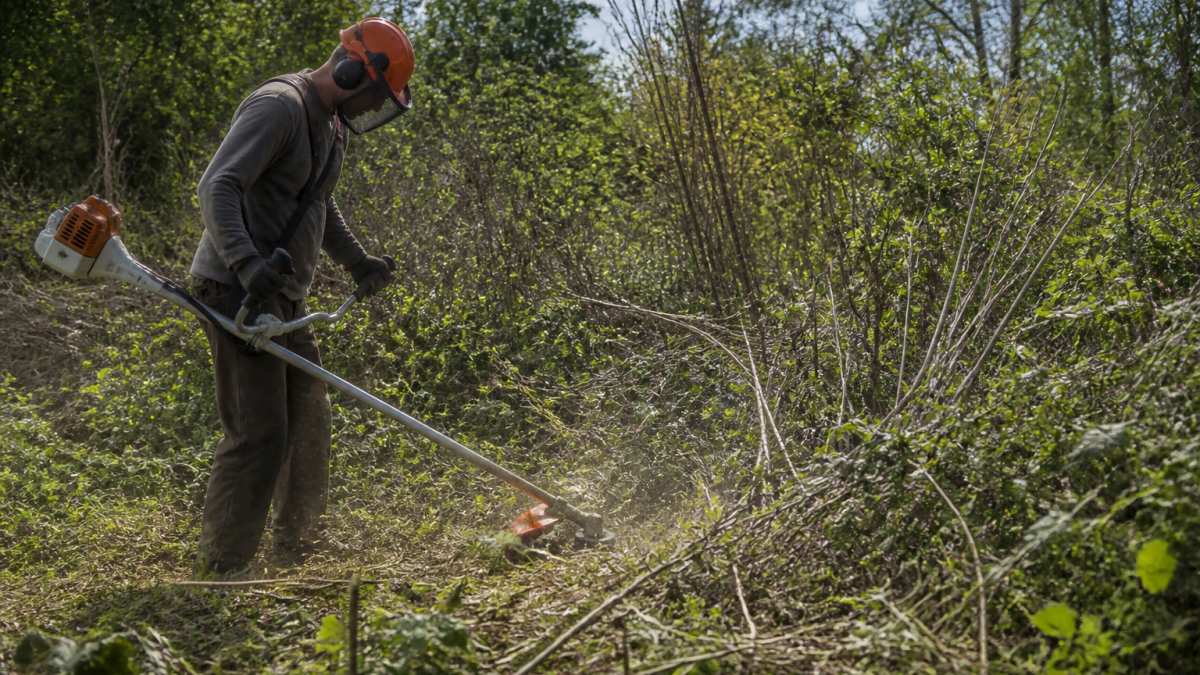
String trimmers and brush cutters use a spinning line or blade.
Chainsaws cut larger wood quickly but demand respect and proper technique.
Stump grinders remove stumps completely, grinding stump and roots into mulch below ground level.
Powered equipment rents affordably by the day or week, so for one-time clearing, renting beats buying.
Heavy-duty equipment for large-scale clearing
Large properties and heavily overgrown land need industrial equipment, where professional help often makes sense.
Brush mowers mount on skid steers or tractors, cutting and mulching vegetation into manageable debris.
Forestry mulchers grind vegetation into fine, reusable mulch, working on larger trees and dense overgrown areas.
Heavy equipment requires training and often professional operation.
How to Clear Brush Without a Tractor
You don't need a tractor to clear overgrown brush, you need a sequence. Most failed DIY jobs stall because the homeowner starts cutting in the middle of the thickest patch, creates a tangle of cut material with nowhere to stand, and quits. The workflow below prevents that.
Step 1: Walk the perimeter and flag what stays
Before any cutting, walk the full boundary. Mark desirable trees, shrubs, and ornamentals with flagging tape or survey stakes. Note property corners, fence lines, utility easements, and buried lines (call 811 before any digging or stump work, it's free and required in most states). Identify hazards: leaning trees, dead limbs overhead, holes, old wire, and glass.
Step 2: Establish a work lane and a debris staging area
Pick one edge as your entry point and clear a lane roughly 3 to 4 feet wide straight through to the far side, giving you a place to stand, a path to drag material out, and an escape route. Designate a staging area on open ground, ideally downwind of your house and away from structures, since fresh brush piles are combustible.
Step 3: Cut high, then cut low (the two-pass method)
This is the biggest efficiency gain for dense stands. On the first pass, cut everything at roughly knee-to-waist height with a brush cutter blade or heavy string trimmer line, you're creating visibility and a stable base, not reaching the ground.
For stems over about 2 inches, switch to a hand saw or chainsaw and cut as low as safely possible without contacting dirt.
Step 4: Work in grids, not circles
Divide the area into manageable blocks, 20 by 20 feet works for hand and handheld power tools. Fully clear one block, drag the material to staging, then move to the next. Working in circles creates the tangled, unwalkable mess that stops most projects.
Step 5: Process debris as you go
Don't let cut material accumulate in the work zone. Sort it at the staging area into three piles: chips/mulch material (under about 3 inches), firewood or burnable logs, and haul-away material. A rented chipper turns the first pile into mulch you can spread on site. See the disposal section below for burning and hauling rules.
Step 6: Treat or remove stumps
For woody species that resprout aggressively, tree of heaven, sumac, black locust, and many others, cutting alone guarantees regrowth. Options are (a) grind the stump with a rented stump grinder, (b) dig it out by hand for small diameters, or (c) cut and immediately apply a labeled stump-treatment herbicide to the fresh cut surface, following the label exactly.
Step 7: Do a regrowth pass
Come back in 3 to 6 weeks and cut anything that resprouted, this second cut is far easier than the first. Two or three regrowth passes over a season exhaust most woody root systems more effectively than a single aggressive cut.
Work in cool morning hours, take breaks every 30 to 45 minutes, and rotate tasks (cutting, dragging, chipping) so you're not holding one posture or gripping one tool for hours. Fatigue is the leading cause of chainsaw and brush cutter injuries.
The Cheapest Way to Clear Brush
Here's how to minimize expenses when you clear overgrown brush.
Do it yourself with hand tools. Pruning shears, loppers, and a hand saw run under $100 total.
Rent powered equipment instead of buying. A brush cutter or string trimmer rents for $30-50 per day.
The cheapest approach depends on your situation. Small yards with light brush favor hand tools.
Best Time of Year to Clear Brush
Timing affects safety, difficulty, and regrowth control.
Fall and early winter are ideal: fallen leaves let you see what you're cutting, slowed growth reduces regrowth, and cooler temperatures mean less physical strain. Late winter through early spring works well before new growth starts, you can see vegetation structure clearly, and spring rains help desirable plants establish after clearing. Avoid summer, when heat increases strain, dense foliage hides what you're cutting, and regrowth happens faster. Avoid late spring, when plants are actively growing and birds may be nesting in brush, so clearing then harms wildlife.
How to Remove Dense Brush Safely
Dense brush hides the things that hurt people: holes, wire, glass, wasp nests, unstable dead limbs, and the previous owner's junk. Treat this as a pre-work checklist, not a formality.
Gear checklist by hazard
| Hazard | Protection |
|---|---|
| Flying debris, branches under tension | Hard hat with full face shield plus safety glasses underneath |
| Cuts from blades, thorns, briars | Cut-resistant gloves (ANSI cut level A4 or higher), long sleeves, chaps when running a chainsaw |
| Uneven ground, hidden holes, rolling logs | Steel-toed boots with lugged soles; consider logger-style boots for chainsaw work |
| Noise from brush cutters and chainsaws | Earplugs or muffs rated NRR 25+ |
| Ticks, chiggers, mosquitoes | Permethrin-treated clothing and EPA-registered repellent on skin; tuck pant legs into socks |
| Poison ivy, oak, sumac | Long sleeves and gloves; wash tools and clothing with cold water and detergent afterward |
| Sun and heat | Wide-brim hat, electrolyte fluids, and a hard stop-time in the heat of the day |
Pre-work hazard sweep
Walk the area before cutting and look for:
- Hanging or leaning dead limbs ("widowmakers") above the work zone. Never work under them; have them removed first.
- Branches under tension, bent saplings and pinned limbs that can snap back. Approach from the side, never in line with the bend.
- Hidden obstacles, old fence wire, rebar, concrete, and glass destroy blades and throw fragments. Probe with a rake or pitchfork before running a cutter through.
- Ground hazards, holes, drop-offs, and soft spots that can roll equipment or twist an ankle.
Tool-specific safety rules
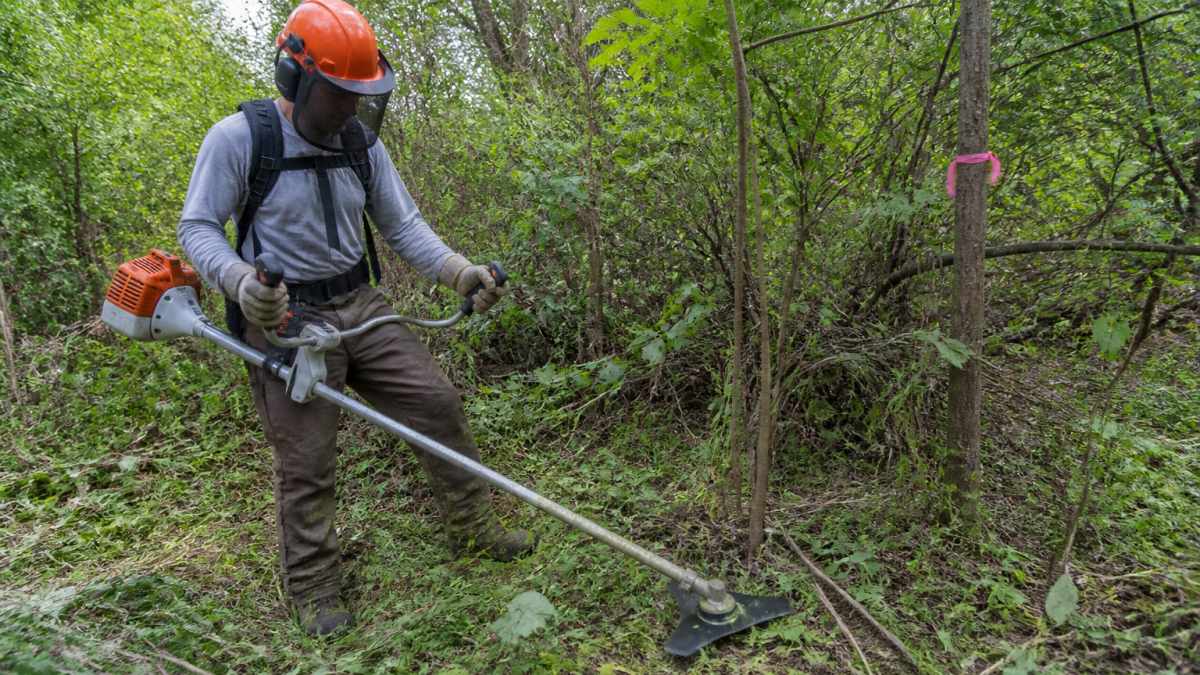
- Brush cutters and string trimmers: Use the correct blade, tri-blade and saw blades for woody stems, string for grass and soft weeds. Keep the guard in place, maintain a firm two-handed grip, never cut above waist height, and watch for kickout when the blade contacts a solid object.
- Chainsaws: Use the chain brake, keep both hands on the handles, and never cut above shoulder height. Kickback happens when the upper bar tip contacts wood, avoid boring with the tip unless trained. Refuel only when the engine is off and cool.
- Machetes and axes: Maintain a clear swing radius of at least twice your arm length. Never swing toward your legs or a partner. Keep the blade sharp, dull blades bounce.
- Stump grinders: Keep bystanders back at least 50 feet; the machine throws debris hard. Wear eye and hearing protection and never reach into the cutting wheel area while it's running.
Working alone protocol
If you must work alone, carry a charged phone, tell someone your start and expected end time, and set a check-in alarm. Keep a first-aid kit and tourniquet in your vehicle; for chainsaw work in remote areas, a personal locator beacon is worth the cost.
If you find poison ivy, oak, or sumac, do not burn it. Urushiol oil in the smoke can cause severe respiratory reactions. Bag it and dispose of it per local rules, or leave it for a professional.
Protecting desirable plants and trees
Before clearing, identify and flag plants and trees you want to keep. Work with hand tools near valuable vegetation for more control, and keep equipment away from tree trunks since bark wounds invite disease and insects. Don't dig or grind within the drip line of trees you're keeping, damaged roots weaken the tree for years.
Handling debris and disposal
Sort as you cut. Chip material under about 3 inches with a rented chipper and use it as mulch; stack larger limbs and logs for firewood or hauling.
When to Hire a Professional
Recognize when the job exceeds your capability or budget.
Hire professionals if your property is heavily overgrown and covers multiple acres.
Hire professionals if the brush includes large or hazardous trees.
Hire professionals if you lack time or physical ability.
Hire professionals if you need debris removed and disposed of properly.
Hire professionals if you need the job done quickly.
Kauffeld Tree Care provides brush clearing, land management, and debris removal for residential and commercial properties.
Frequently Asked Questions
What is the best way to clear brush without a tractor?
For smaller properties without heavy equipment access, combine hand tools and powered equipment. Start with loppers and pruning shears for saplings and shrubs, then use a brush cutter or string trimmer for undergrowth and weeds. A chainsaw handles larger woody growth. Break the work into manageable sections, removing debris as you progress. This method works well on properties under one acre where tractor access is limited or would damage desirable landscaping.
What is the cheapest way to clear brush?
Manual hand tools have the lowest upfront cost: pruning shears, loppers, axes, and machetes require only a one-time purchase of $50-$200 total. For larger areas, renting a brush cutter or string trimmer ($30-$60 per day) beats purchasing. If you have significant woody growth or dense brush, hiring a professional service with forestry mulching equipment may actually cost less than days of manual labor plus equipment rental, especially when debris removal is included.
What is the best time of year to clear brush?
Late fall through early spring is ideal. Deciduous trees have lost their leaves, improving visibility and making it easier to identify what you're cutting. The ground is often firmer, reducing equipment rutting and damage. Avoid spring nesting season (March-June) to protect wildlife. Summer heat and humidity make the work uncomfortable and increase fire risk in dry conditions. Winter dormancy also means less regrowth immediately after clearing, giving you a longer window before maintenance is needed again.
When should you hire a professional to clear brush?
Hire professionals for heavily overgrown areas, dense brush with large saplings or small trees, properties over one acre, or when hazardous trees are present. If clearing requires operating heavy equipment like brush mowers, skid steers, or mulchers, professional service saves time and prevents property damage. Emergency situations, storm damage, trees leaning toward structures, demand immediate professional attention. Professionals also handle debris removal and can apply forestry mulching, which eliminates ongoing disposal costs.