 blog
blog
Stump Grinding vs Complete Root Removal: What to Know
Table of Contents
- Stump Grinding vs Complete Root Removal: Key Differences
- Does Stump Grinding Remove Roots? What's Left Underground
- How Deep Does Stump Grinding Go?
- Stump Grinding Cost vs Full Root Removal Pricing
- Tree Stump Removal Without Grinding: Manual and Mechanical Options
- Underground Hazards, Soil Impact, and Site Restoration
- Which Method Fits Your Property? A Decision Framework
- Frequently Asked Questions
Last Updated: October 10, 2026
Stump Grinding vs Complete Root Removal: Key Differences
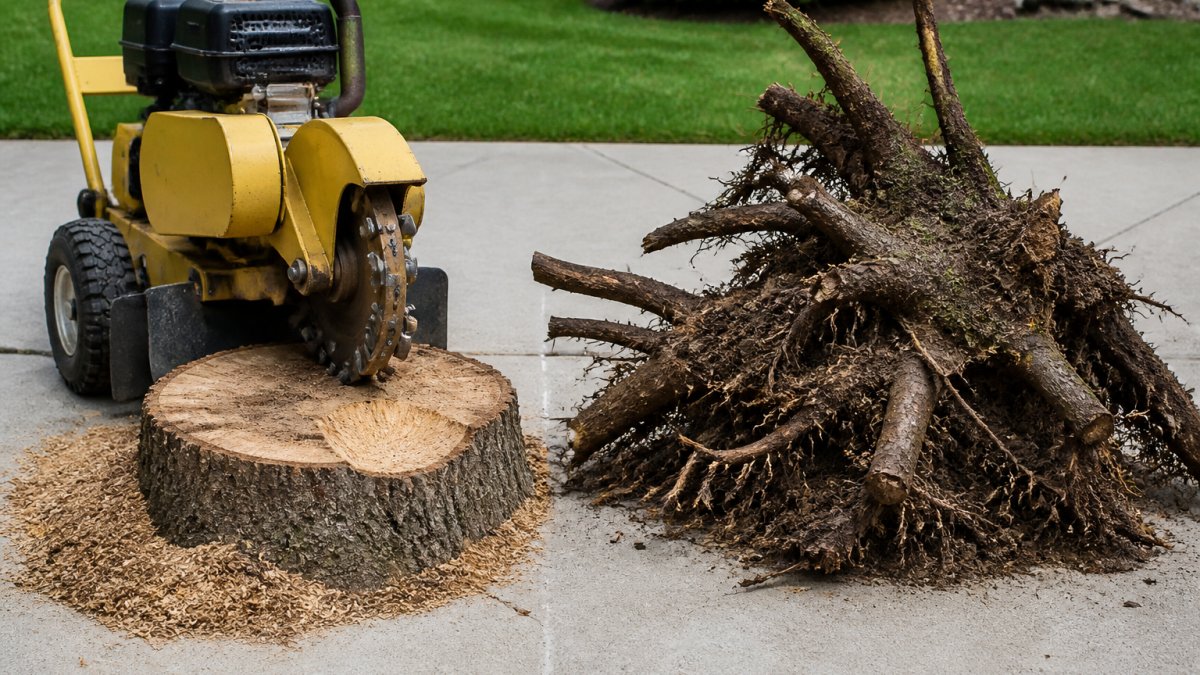
Stump grinding vs complete root removal is the choice between grinding a stump down below the soil surface and extracting the entire root system. Grinding leaves the roots in place; complete root removal takes them out.
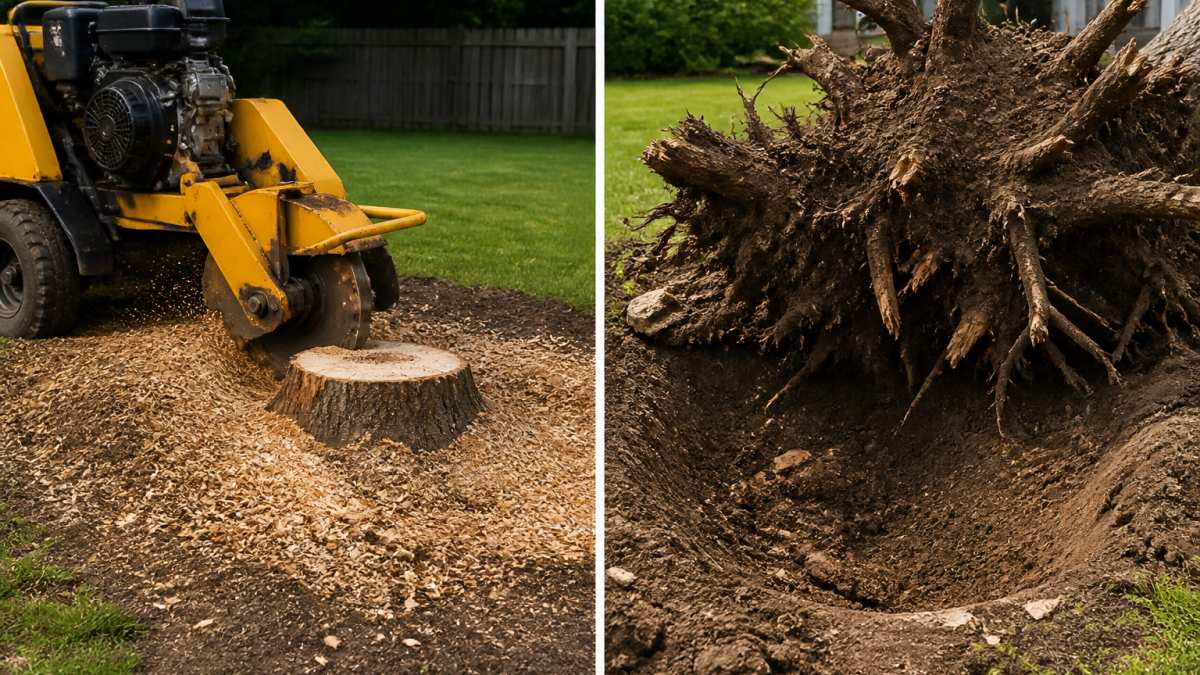
Grinding is faster, cheaper, and less disruptive. Full extraction is slower, costs more, and tears up more yard. Which you need depends on what you plan to do with that patch of ground next.
What Stump Grinding Actually Removes
Stump grinding removes the visible stump and upper root flare, cutting the wood down below grade. The machine's carbide wheel chips the stump into small pieces, typically left in the hole or raked out as grindings. What stays behind: the lateral roots under your lawn, the taproot where one exists, and the root ball, which decompose slowly over years.
What Complete Root Removal Involves
Complete root removal, sometimes called total root extraction, is the physical removal of the stump, the root ball, and the major structural roots. It's excavation work, not grinding work, usually requiring a mini excavator or stump puller plus hand work around anything the machine can't reach.
The result is a genuine hole where the tree used to be: clean soil you can replant into immediately, but a yard that looks like a construction site for a few days.
Does Stump Grinding Remove Roots? What's Left Underground
Stump grinding does not remove roots. It removes the stump. The root system stays in the ground, which is the single most misunderstood point in this comparison.
Those buried roots decay over time, at a rate that depends on species and soil conditions. Some woods break down within a few years; denser species hold their structure much longer. In the meantime, they can:
- Send up suckers from the roots on species that sprout readily
- Create soft spots in the lawn as the wood rots and the soil settles
- Harbor fungi, including some that spread to nearby living trees
None of that is a disaster, just predictable, and it's why the answer to "does stump grinding remove roots" matters for your site plan.
How Deep Does Stump Grinding Go?
Stump grinding typically goes 6 to 12 inches below ground level, measured from the top of the stump.
A grinder can only cut as deep as its wheel allows, and most residential machines reach roughly 12 inches below grade on a single pass.
Match the depth to the end use:
| Your Plan for the Area | Recommended Grinding Depth | Why |
|---|---|---|
| Leave it as lawn | 6-8 inches below grade | Enough to cover with topsoil and seed |
| Plant grass or groundcover | 8-10 inches below grade | Prevents settling dips in the lawn |
| Install a patio or walkway | 10-12 inches below grade | Base material needs stable, compacted soil |
| Replant a tree in the same spot | Full root removal instead | New roots need clean soil, not old wood |
| Build a structure or driveway | Full root removal instead | Load-bearing soil can't contain voids |
That last row is the one people ignore. Pour concrete over a ground stump and the wood underneath rots, the soil settles, and the slab cracks.
Stump Grinding Cost vs Full Root Removal Pricing
Stump grinding costs less than full root removal in nearly every case, and the gap is usually substantial. Grinding is a one-machine, part-day job. Full extraction is excavation, hauling, and backfill.
Pricing for both depends on factors a quote should itemize:
- Stump diameter at the widest point, not the height
- Access for the grinder or excavator, including gate width and slope
- Depth required based on your end use
We don't publish flat rates because a 12-inch stump behind a fence and a 40-inch stump beside a driveway are not the same job. Ask any provider for an itemized quote separating grinding, disposal, and restoration.
Tree Stump Removal Without Grinding: Manual and Mechanical Options
Tree stump removal without grinding falls into two categories: manual and mechanical. Both take the stump and roots out rather than reduce them in place.
Manual removal works for small stumps, typically saplings and shrubs.
Mechanical removal uses equipment:
- Mini excavator: digs around and lifts the root ball out. Best for larger stumps with reasonable access.
- Stump puller or winch: applies use to pull the stump and root plate. Effective on stumps with shallow, wide root systems.
- Backhoe: combines digging and lifting on sites with room to maneuver.
There's also chemical stump removal, which accelerates decay rather than removing anything.
The right choice comes down to access and stump size. A mini excavator can't get through a 36-inch gate, and a stump puller needs something to anchor against.
Underground Hazards, Soil Impact, and Site Restoration
Underground hazards get almost no attention, yet they cause real damage. Before any grinding or excavation, you need to know what's buried near that stump. The single most useful step is a free utility locate, and the step most homeowners skip.
Pre-Work Checklist Before Any Grinding or Excavation
Work through this in order. It takes an afternoon and prevents mistakes that cost thousands.
- Call 811 at least two to three business days before digging. This national call-before-you-dig service is free and legally required before excavation in most states (Call Before You Dig! | Stakeholder Communications). Locators mark gas, electric, water, sewer, and communications lines with paint or flags. Grinding near a marked line is manageable with care; excavating near an unmarked one is how neighborhoods lose power or a gas line gets struck.
- Walk the area and photograph the marks before any equipment arrives. Marks fade, and a photo gives you a record if a line is later damaged.
- Map private lines yourself. 811 typically marks the utility's side up to the meter, not private irrigation, landscape lighting, or a line running to a detached garage or shop. Trace sprinkler heads, valve boxes, and low-voltage lighting runs and flag them.
- Locate the septic tank and drain field. If the property has a septic system, the tank lid and drain field must not be driven over or excavated near. A failed drain field is a five-figure repair.
- Check clearance to the foundation. Roots near a house often run under the slab or footing. Note the distance from the stump to the nearest foundation wall, retaining wall, or porch pier.
- Confirm equipment access. Measure the narrowest gate, the slope of the path, and any overhead lines. A mini excavator needs roughly a 36-inch gate at minimum; a stump grinder needs a clear path and room to swing its wheel.
- Mark the work zone with cones or stakes so the operator and any helpers stay clear of the marks.
What Each Method Does to the Soil
Soil impact differs between the two methods, and the difference matters more than most people expect.
Grinding leaves soil structure mostly intact, you're removing wood, not earth. The trade-off: grindings left in the hole are a wood-and-soil mix, not clean topsoil.
Extraction removes the root ball, taking a large volume of soil with it and creating a void that must be backfilled and compacted.
Restoration After Grinding
Site restoration after grinding is straightforward but not instant:
- Rake out excess grindings and set them aside for mulch or haul them off.
- Backfill with clean topsoil to grade, tamping in shallow lifts rather than dumping it all at once.
- Seed or sod, and water according to the seed mix.
Restoration After Full Extraction
Restoration after full extraction takes more work and material. You're filling a substantial hole, and the fill must be compacted in lifts of 6 to 8 inches rather than dumped in one pass, or it settles unevenly and leaves a depression. If you're replanting, this is the benefit: clean soil, no competing root mass, a proper planting hole. If you're building, the compacted fill is what lets a slab or footing perform as designed.
Which Method Fits Your Property? A Decision Framework
Most comparisons stop at "grinding is cheaper, extraction is more thorough." True but not useful. The better question is what that patch of ground needs to do next, because the answer changes the method, the depth, and the cost. Find the scenario below that matches your plan.
Match the Method to the Next Use of the Site
| What You Plan to Do | Recommended Method | Why |
|---|---|---|
| Return the area to lawn | Stump grinding, 6-8 inches below grade | Enough to cover with topsoil and seed; roots decay in place |
| Plant grass or groundcover | Stump grinding, 8-10 inches below grade | Prevents settling dips in the lawn |
| Install a patio, walkway, or pavers | Stump grinding, 10-12 inches below grade, or extraction | Base material needs stable, compacted soil; deep grinding may suffice for light loads |
| Pour a slab, footing, or driveway | Complete root removal | Load-bearing soil can't contain voids that will settle |
| Replant a tree or large shrub in the same spot | Complete root removal | New roots need clean soil, not decaying wood |
| Build a structure, addition, or retaining wall | Complete root removal | Footings require undisturbed or properly compacted soil |
| Clear a lot for development | Complete root removal | Buildable ground requires no buried wood |
| Leave it naturalized or as a wildlife area | Stump grinding, 6-8 inches below grade | Lowest cost and disruption; roots decay naturally |
A Transparent, Itemized Cost Framework
Quotes vary widely because the job varies widely. Instead of a flat rate, ask for a quote that separates these line items so you can compare providers fairly.
Factors that drive the price:
- Stump diameter at the widest point, not the height, the single biggest driver, since it determines how long the grinder or excavator works.
- Root spread and root ball size. A wide, shallow root system is easier to extract than a deep taproot. Species matters.
- Access. A stump beside a driveway is a different job than one behind a fence, on a slope, or in a tight side yard. Limited access may require smaller equipment and more hand work.
How grinding and extraction differ on the invoice:
Grinding is typically a one-machine, part-day job; the quote covers the grinding itself plus optional debris removal and restoration.
We don't publish flat rates because a 12-inch stump behind a fence and a 40-inch stump beside a driveway are not the same job.
When to Get a Professional Assessment
Some situations are beyond a homeowner decision:
- You don't know what's buried in the area, or 811 marks show lines close to the stump.
- The stump sits near a foundation, retaining wall, or utility easement.
- The stump is unusually large or has been in the ground for years, so the root system is extensive.
For most residential yards, grinding wins on cost and disruption. For anything involving building, planting, or clearing for development, extraction is the only answer that holds up. The decision usually makes itself once you know what the ground needs to do next. If you'd rather not sort through it alone, Seth Kauffeld can assess your site and recommend the right method.
Frequently Asked Questions
Is stump removal and stump grinding the same thing?
No. Stump grinding uses a rotating cutting wheel to chip the stump down below ground level, usually 6 to 12 inches deep, leaving the root system in the soil. Complete root removal goes further and extracts the root ball and major structural roots through excavation or mechanical pulling. Grinding is faster, less invasive, and more affordable, while full removal clears the entire underground structure. The right choice depends on whether you plan to replant, build, or simply restore the lawn.
Does stump grinding remove the roots?
Stump grinding does not remove the roots. It grinds the visible stump and the top portion of the root flare, but the lateral roots and root ball stay buried. Those roots slowly decay over several years and can cause soil settling or sinkholes as they break down. If you need the ground fully clear for construction, replanting, or utility work, complete root removal is the better option. Otherwise, grinding handles most residential situations well.
What is the best way to get rid of a stump without grinding?
Tree stump removal without grinding typically means mechanical extraction, chemical stump killers, or burning. Mechanical removal uses a mini-excavator or stump puller to lift the root ball out, which clears the whole structure but disturbs more soil. Chemical treatments take months to work and leave the wood in place. Burning is restricted in many areas and risky near structures. For most homeowners, grinding remains the fastest and least disruptive route.
How much stump should be left for grinding?
Leave the stump cut as close to ground level as possible, ideally 6 inches or less above the soil. A lower cut gives the grinder easier access and reduces the time and cost of the job. If the stump is taller, the crew may need to make an extra cut before grinding. Clear debris, rocks, and nearby plants from around the base so the equipment can reach the stump without obstruction.