 Ultimate guide
The Ultimate Guide to Large Scale Land Clearing Equipment
Last Updated: November 19, 2026
Quick Summary
Matching large scale land clearing equipment starts with terrain slope, vegetation density, and access room, not acreage. Tracked machines hold grade better on slopes, mulchers handle brush and saplings, and dozers or excavators take mature hardwoods and stumps. Most large acreage jobs use more than one machine class.
- Acreage tells you how long a job runs; terrain tells you what can physically get there.
- A forestry mulcher leaves mulch in place with no burn pile, windrow, or bare soil.
- Skid steers and compact track loaders fit through gates a dozer cannot pass.
- A per-acre quote without a stated production assumption is a number without a basis.
- For a single lot clearing, rental usually beats buying land clearing equipment.
Table of Contents
- Matching Land Clearing Equipment to Your Site and Acreage
- Heavy-Duty Land Clearing Equipment Compared: Mulchers, Dozers, and Excavators
- When a Forestry Mulcher for Land Clearing Beats a Dozer
- Attachments That Extend Machine Capability: Grapples, Tree Shears, and Stump Cutters
- Equipment Sizing and Production Estimates for Large Acreage
- Land Clearing Equipment Rental vs. Purchase: Cost and ROI
- Buying Used Large Scale Land Clearing Equipment Safely
- Safety, Training, and Regulatory Requirements for Land Clearing
- Debris Handling, Erosion Control, and Post-Clearing Outcomes
- Planning Your Commercial Land Clearing Project with a Certified Arborist
- Frequently Asked Questions
Matching Land Clearing Equipment to Your Site and Acreage
Matching large scale land clearing equipment to your site starts with three variables: terrain slope, vegetation density, and how much room a machine has to move. Get those wrong and the biggest, most expensive machine on the lot becomes a liability. Machine size should follow the ground the work happens on, not the acreage on the deed.
Acreage tells you how long a job runs. Terrain tells you what can physically get there. A 40-acre flat pasture and a 40-acre hillside with a creek crossing are two completely different projects.
Terrain, Vegetation Density, and Access Constraints
Slope is the first filter. Tracked machines hold grade better than wheeled ones, and rubber-track loaders handle moderate slopes that would stop a wheeled skid steer. Steep ground pushes you toward tracked carriers and winch-assisted work.
Vegetation density determines cutting capacity. Saplings under a few inches across fall to a mulching head. Mature hardwoods need a dozer, a shear, or a saw. Dense brush slows every machine, and the slowdown compounds across acreage.
Access is the constraint most estimates miss. Gates, culverts, fence lines, and soft ground all limit machine width and weight. If you want a step-by-step method for the dense stuff, see our guide on how to clear overgrown brush.
Heavy-Duty Land Clearing Equipment Compared: Mulchers, Dozers, and Excavators
Each machine class solves a different problem, and most large acreage jobs use more than one. The comparison below reflects how these machines actually divide work on a clearing site.
| Machine | Best For | Main Limitation | Typical Site |
|---|---|---|---|
| Forestry mulcher | Brush, saplings, light trees | Struggles with large hardwoods | Pasture, lots, right-of-way |
| Dozer | Moving soil, pushing trees and stumps | Leaves debris piles, scars topsoil | Open, level ground |
| Excavator | Stumps, root balls, precise removal | Slower on light vegetation | Mixed terrain, tight access |
| Skid steer / CTL | Access, cleanup, attachment work | Limited reach and power | Finished lots, tight spaces |
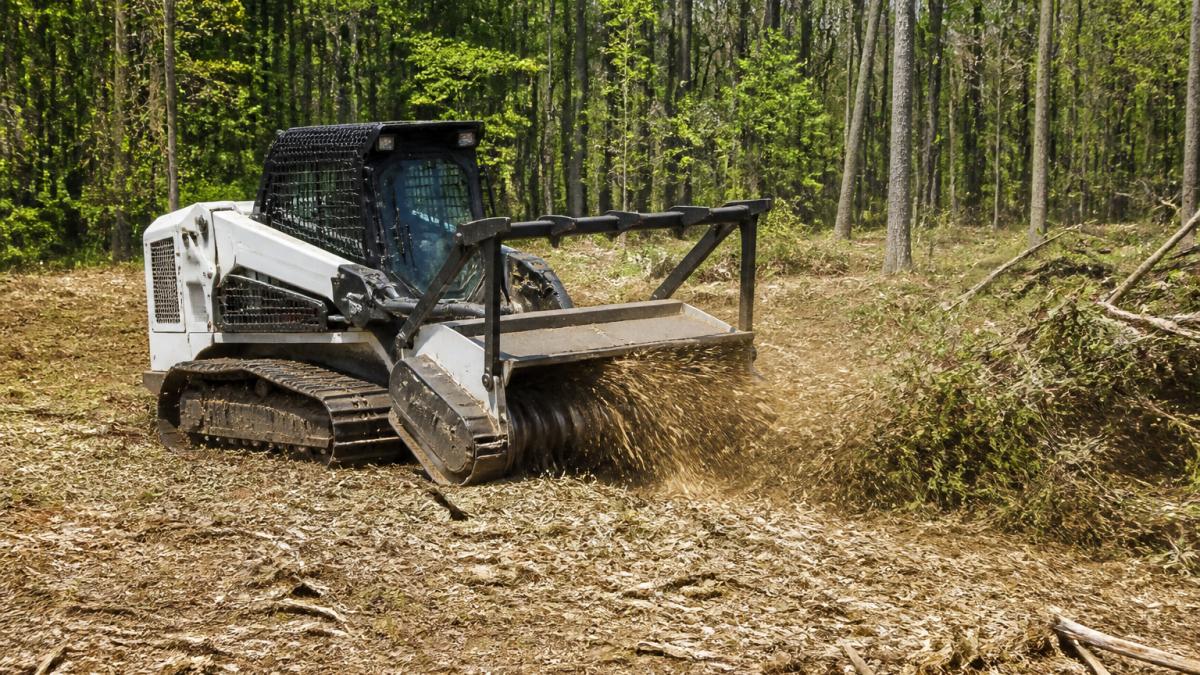
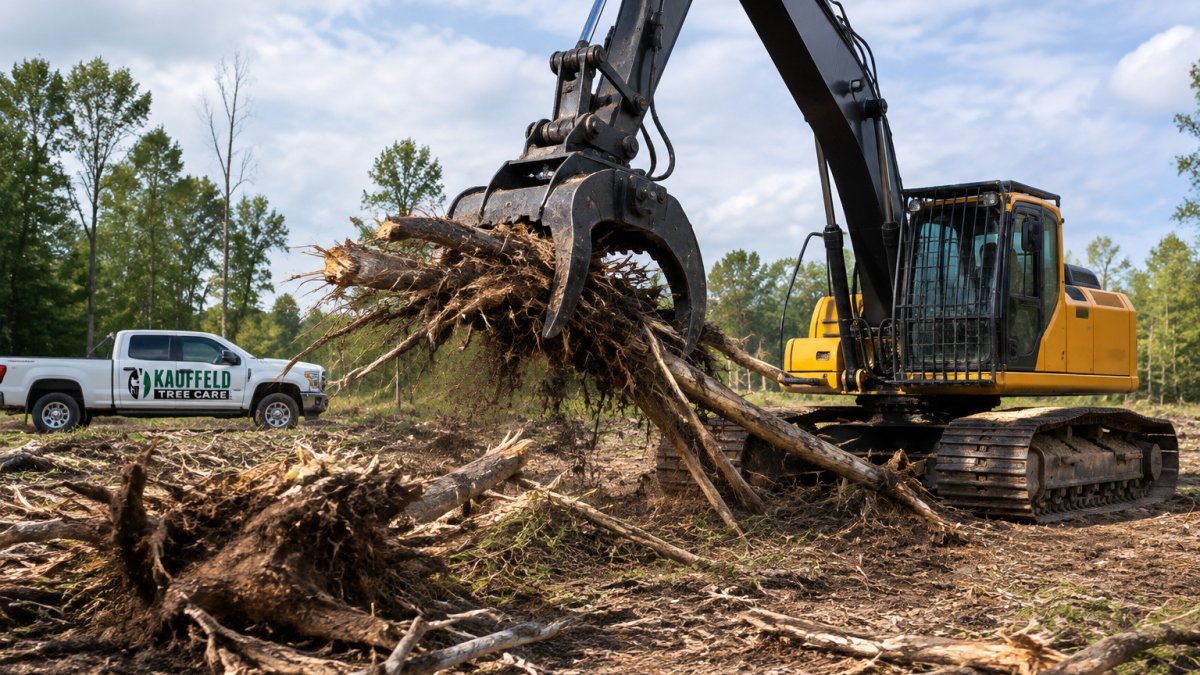
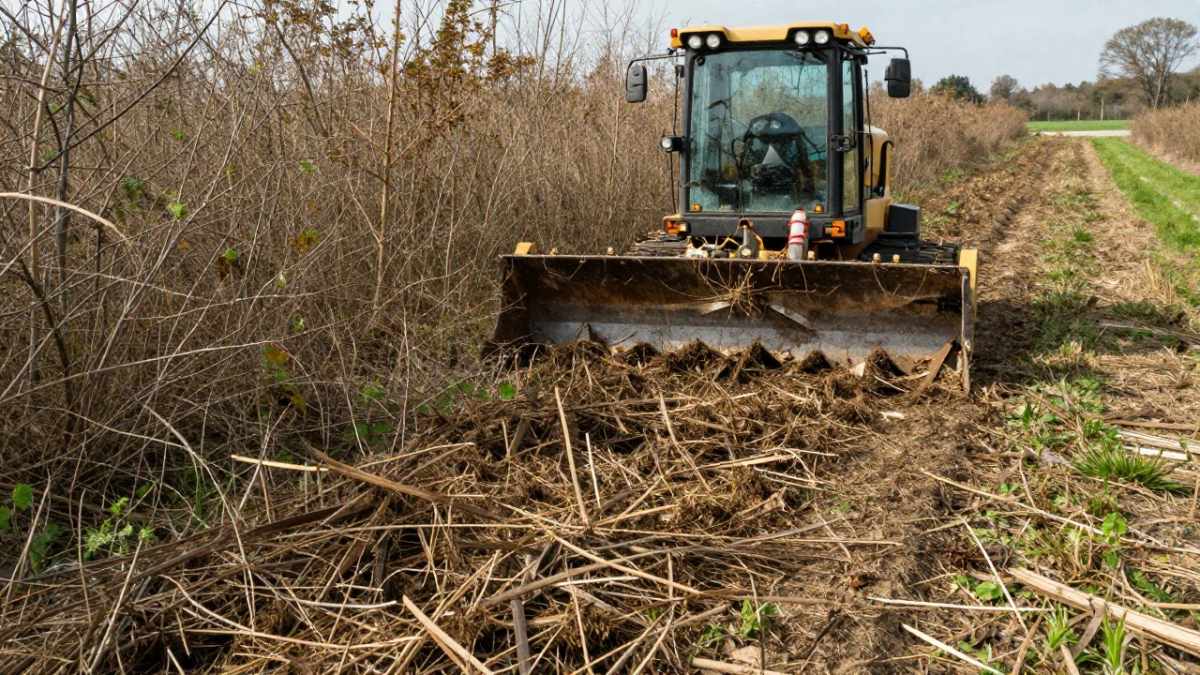
A dozer is the classic tool for pushing material into windrows. It is fast on open ground and slow to clean up after. An excavator pulls stumps whole and grinds root balls where they sit, which keeps soil in place. A forestry mulcher turns standing brush into mulch in a single pass, leaving the ground covered instead of scarred.
Skid Steers, Compact Track Loaders, and Forestry Cutters
Skid steers and compact track loaders are the machines that finish a job. They fit through gates a dozer cannot pass and carry forestry cutters, grapples, and buckets on the same chassis.
- Skid steer: cheaper, simple, best on hard ground
- Compact track loader: better flotation and grade-holding, preferred on soft or sloped ground
- Forestry cutter: a dedicated cutting head for brush and small trees
- Brush cutter: lighter-duty, good for grass and thin stems
The trade-off is production. A compact loader with a forestry cutter clears a fraction of what a dedicated mulcher does per hour, but it reaches places the big machine never will.
When a Forestry Mulcher for Land Clearing Beats a Dozer
A forestry mulcher for land clearing wins whenever you want the ground left usable, not stripped. It cuts and grinds vegetation in place, spreading mulch evenly behind the machine. There is no burn pile, no windrow, and no bare soil to erode.
That matters on residential lots, creek banks, fence lines, and any site where the topsoil needs to stay put. A dozer pushes everything into piles, which means a second machine and a second pass to deal with the debris.
The limits are real. A mulcher handles brush and saplings well and slows down on large hardwoods. On rocky ground, cutting teeth take a beating. For a deeper look at the method, read our complete guide to forestry mulching for land clearing.
Attachments That Extend Machine Capability: Grapples, Tree Shears, and Stump Cutters
Attachments turn one carrier into several machines, which is how contractors control cost on large acreage. The right attachment often matters more than the base machine.
- Grapple: picks up logs, brush, and debris for piling or loading
- Tree shear: cuts a standing tree at the base and holds it for placement
- Tree puller: grips and pulls saplings and small trees roots and all
- Stump cutter: grinds stumps below grade without excavation
- Mulching head: mounts on excavators and loaders for brush work
Stump cutters deserve a note. Grinding removes the visible stump and leaves the root system to decay; full root removal digs it out entirely. Before you choose, compare stump grinding versus complete root removal so you know what the site actually needs.
Equipment Sizing and Production Estimates for Large Acreage
Production estimates are where budgets are won or lost. Clearing work is often quoted by the acre, and the per-acre rate can vary with vegetation, terrain, and the size of the machine on site.
The practical way to size equipment is to work backward from production. Production is acres cleared per hour or per day, and it is a function of cutting width, travel speed, vegetation load, terrain, and downtime.
Production varies widely with conditions. A dedicated forestry mulcher in light brush and saplings on gentle ground typically clears far more ground per day than in dense brush, mature hardwoods, or on steep slopes.
Vegetation density is the biggest swing factor. Saplings under a few inches across fall to a mulching head at near-full travel speed. Trees above the cutting capacity of the head force the operator to slow down, reposition, or bring in a shear, saw, or dozer.
Terrain changes the math again. Slope reduces travel speed, increases wear on tracks and cutting teeth, and can push the job toward tracked carriers or winch-assisted work. Wet ground and creek crossings limit machine weight and require mats, culverts, or a different access plan.
Use this checklist to size a machine to a job:
- Measure the acreage and map vegetation types by area, not as a single average
- Note slope, wet ground, creek crossings, and any restricted-access zones
- Confirm gate widths, culvert capacity, and haul routes for transport
- Identify trees above the mulcher's cutting capacity and plan a second machine for them
- Decide where debris will go and whether it stays on site as mulch or gets hauled
- Get a per-acre rate and a stated production assumption in writing
- Ask how weather, downtime, and support equipment are built into the estimate
A machine that is undersized for the vegetation will burn hours and fuel without finishing. An oversized machine on a small, tight lot costs more per hour than the job justifies and may not fit through the access.
Watch out: a per-acre quote that does not state its production assumption is a number without a basis. Two contractors can quote the same acreage at very different rates because one assumes light brush and the other assumes mature hardwoods and steep slope. Make the assumption explicit before comparing bids.
Land Clearing Equipment Rental vs. Purchase: Cost and ROI
Rental and purchase each suit different kinds of work, and the right choice depends on how often equipment is needed.
| Factor | Rental | Purchase |
|---|---|---|
| Upfront cost | Low, per day or week | High, plus financing |
| Maintenance | Included | Owner's responsibility |
| Downtime risk | Swap the machine | Repair or rent a backup |
| Best for | One-time or seasonal work | Year-round operations |
For a single lot clearing, land clearing equipment rental usually beats buying. For a contractor clearing acreage every season, ownership wins on cost per hour, provided the machine stays busy. Rental pricing changes with demand and machine size, so compare current quotes before deciding.
Buying Used Large Scale Land Clearing Equipment Safely
Used machines stretch a budget, and the risk sits in the undercarriage and the hydraulics. Those two systems absorb the punishment on clearing work, and they are the most expensive to repair.
Check these before you buy:
- Undercarriage wear: tracks, rollers, sprockets, and idlers
- Hydraulic leaks, hose condition, and cylinder scoring
- Cutting head condition: teeth, bearings, and rotor balance
- Service records and hour meter accuracy
- Cooling system condition after heavy brush work
Watch out: a machine sold with a fresh coat of paint can hide a worn undercarriage, and replacing tracks on a large tracked machine is a major expense. Run it under load before money changes hands.
Safety, Training, and Regulatory Requirements for Land Clearing
Land clearing carries real risk: falling trees, rotating cutting heads, rollovers, flying debris, and dust. Operators need training on the specific machine, and machines should be equipped with guards and rollover protection. A common mistake is treating a mulcher like a lawn mower. It is not.
Operator qualification starts with the machine class. A forestry mulcher, a dozer, an excavator, and a compact track loader each have different controls, stability limits, and cutting behavior, and time on one does not qualify an operator for another.
Exclusion zones are the core of cutting-head safety. No one should stand in the direction the head throws material, and no one should work under a leaning tree or inside the swing radius of an excavator-mounted head.
Utility locating belongs before the first cut, not after. Call the state one-call service to have underground electric, gas, water, sewer, and communications lines marked, and treat the marks as approximate.
Fire prevention is a seasonal and site-specific obligation. Cutting heads and dozers can throw sparks on dry ground, and mulched material piles can heat up.
Environmental restrictions vary by site and jurisdiction. Before work starts, check local rules on burning, erosion and sediment control, wetlands and waterways, and protected species and habitat. Our guide on hiring insured tree care companies covers what to ask for and how to verify coverage.
Jobsites also need basic controls that are easy to skip on a large acreage job: traffic and haul-route planning, dust suppression, fuel and hydraulic-fluid containment, and a plan for what happens if a machine breaks down in a sensitive area.
Watch out: utility marks are approximate and can be missing or moved. Hand-dig or pothole near marked lines before cutting, and stop immediately if you uncover an unmarked line or a line that is not where the mark indicates.
Debris Handling, Erosion Control, and Post-Clearing Outcomes
What happens to the debris decides how the site looks six months later. Mulching leaves material on site as ground cover, which holds moisture and slows erosion. Pushing and piling concentrates debris, which means burning, hauling, or chipping it later.
Erosion control belongs in the plan from day one. Bare soil on a slope washes away with the first heavy rain, and sediment leaving a site can create liability. Leave mulch in place, seed exposed ground quickly, and install silt fencing where water runs off.
Post-clearing outcomes worth planning for: a usable building pad, a replanted buffer, or a maintained brush line. Decide the end state before the first machine arrives.
Planning Your Commercial Land Clearing Project with a Certified Arborist
Commercial projects can benefit from a certified arborist's review before equipment arrives. An arborist identifies trees worth keeping, trees that are hazardous, and trees that fall under local protection rules. That review prevents expensive mistakes and rework.
Property managers with multiple sites should also confirm the contractor can handle volume, scheduling, and documentation across locations. Review the range of tree removal services for commercial properties to see what a full-service scope includes.
Kauffeld Tree Care is a certified arborist-led and fully insured operation, offering 24 hour emergency service for storm damage.
Large acreage clearing goes wrong when the machine is chosen before the site is understood. Start with terrain, vegetation, and access, then match the equipment and the contractor to what the ground allows. Kauffeld Tree Care brings certified arborists, crane and bucket truck capability, forestry mulching, stump grinding, and storm debris cleanup to residential and commercial properties in Watertown and surrounding communities. Get started with Kauffeld Tree Care and put a clear, safe plan behind your next land clearing project.
Frequently Asked Questions
What equipment is used for large-scale land clearing?
Large-scale land clearing typically combines several machines rather than relying on one. Forestry mulchers and masticators handle dense brush and saplings, dozers push over larger trees and move soil, excavators with grapples or tree shears remove stumps and root balls, and skid steers or compact track loaders clear debris from tight areas. On big acreage, the most efficient setups pair a mulcher for vegetation with an excavator for stump removal, then a dozer or loader for grading. The right mix depends on terrain, tree size, and how you plan to use the land afterward.
How many acres can a forestry mulcher clear in a day?
Production varies widely with vegetation density, tree size, terrain, and operator skill. In light brush and saplings, a high-flow tracked mulcher can cover several acres in a working day. Dense brush with larger trees slows production considerably, and rocky or steep ground slows it further. Rather than quoting a flat acreage figure, ask an operator to walk the site and estimate based on what is actually growing there. A forestry mulcher for land clearing is fastest on overgrown pasture and brush, slower on mature timber.
Is it better to rent or buy land clearing equipment?
Rent when the job is a one-time clearing project, when you need a specialized machine for a few weeks, or when you want to test a machine before committing. Buy when you clear land regularly, when rental availability in your area is unreliable, or when downtime costs more than ownership. Factor in transport, fuel, insurance, maintenance, and operator wages on top of the rental rate or purchase price. For a single residential lot, land clearing equipment rental usually wins on cost. For recurring commercial work, ownership often pays back within a few seasons.
What is the difference between a forestry mulcher and a dozer?
A forestry mulcher grinds standing vegetation, brush, and saplings into mulch in a single pass, leaving the root system and topsoil largely intact. A dozer pushes trees over and moves soil, which disturbs the ground far more and requires separate debris disposal. Mulching suits sites where you want to preserve topsoil and reduce erosion, such as lot preparation or right-of-way maintenance. Dozers suit work that requires root removal, grading, or moving large volumes of earth. Many large projects use both: mulch the vegetation first, then bring in a dozer for grading.
What should I check before buying used large scale land clearing equipment?
Start with hours on the machine and on major components, not just the chassis. Ask for maintenance records, inspect the undercarriage on tracked machines, check for hydraulic leaks and hose condition, and look at cutting head wear on a mulcher. Verify the machine has not been in a major accident and confirm parts availability for that model. Have a mechanic inspect it before purchase, and factor in the cost of immediate repairs. Used equipment can be a strong value, but only when the service history is documented.
What safety and training requirements apply to land clearing work?
Land clearing falls under general occupational safety rules. Employers must follow OSHA standards for machine operation, rollover protection, and hazard communication, and operators should be trained on the specific machines they run. Work near power lines, on steep slopes, and around felled trees carries serious risk and calls for established safe procedures. Many states also require utility locate requests before digging or stump removal. Insurance carriers often set their own training expectations. Confirm your operator's certifications and insurance coverage before work begins.