 Ultimate guide
Residential Tree Maintenance and Safety Tips for Homeowners
Last Updated: November 10, 2026
Quick Summary
Residential tree maintenance protects people, your home, and property value, so inspect your trees twice a year for cracks, dead branches, fungal growth, and root problems. Prune in late winter dormancy, remove dead, damaged, and diseased wood first, and never remove more than 25 percent of live canopy in one year. Call a professional for any work near power lines or above shoulder height.
- Walk your property twice a year and rank defects as act now, schedule within the season, or monitor.
- Cut just outside the branch collar and avoid flush cuts and stubs.
- Water deeply and infrequently so moisture reaches 12 to 18 inches down.
- Spread 2 to 4 inches of organic mulch but keep it a few inches back from the bark.
- A tree belongs to the owner of the land where its trunk sits, not where branches hang.
Table of Contents
- Why Residential Tree Maintenance Matters for Safety and Property Value
- Tree Hazard Assessment: Spotting Risks Before They Become Emergencies
- Tree Pruning Tips That Protect Canopy Health
- Tree Disease Signs Every Homeowner Should Recognize
- Watering, Mulching, and Soil Care in the Root Zone
- Fertilizing and Pest Prevention Without Overdoing It
- A Seasonal Maintenance Calendar for Wisconsin Properties
- Tree Maintenance Responsibility: Who Handles What on a Residential Property
- Utility Lines, Storm Damage, and When to Step Back
- DIY or Professional Arborist: Decision Rules for Homeowners
- Frequently Asked Questions
Why Residential Tree Maintenance Matters for Safety and Property Value
Tree work carries a published fatality rate of 20.9 per 100,000 full-time workers, according to Start Business By State industry safety statistics. That number explains why residential tree maintenance is not a cosmetic chore. It is risk management. At Kauffeld Tree Care, we see the same pattern on property after property: the trees that hurt people or crush roofs are rarely the ones that looked sick for months. They are the ones nobody inspected.
Good tree maintenance protects three things at once: the people under the canopy, the structure of your home, and the value of your lot. Mature trees shade a house, cut cooling costs, and anchor a landscape. The Urban Trees and Human Health scoping review describes urban forests as critical green infrastructure delivering environmental, economic, social, and health benefits to residents. Lose a mature tree to neglect and you lose decades of that value in an afternoon.
The stakes are higher than most homeowners assume. Tree care incidents cause roughly 70 worker deaths and thousands of injuries annually, per the Safety@Work newsletter. A property owner who climbs a ladder with a chainsaw joins that statistic pool. Below, we break down the routine care that keeps trees healthy and the warning signs that mean you should step back and call a professional.
Tree Hazard Assessment: Spotting Risks Before They Become Emergencies
Tree hazard assessment is the practice of inspecting a tree for defects that could cause it, or part of it, to fall on people or property. A hazard exists when a defect meets a target: a house, a driveway, a power line, a play area. No target, no emergency.
Walk your property twice a year and look for these:
- Cracks and splits in the trunk or where large limbs meet the main stem
- Lean that changed since you last looked, especially after a storm
- Dead branches hanging in the canopy, called widow-makers for good reason
- Fungal growth like conks or mushrooms on the trunk or root flare
- Cavities and hollows you can see from the ground
- Root problems: severed roots, soil heaving, or a trunk that moves when pushed
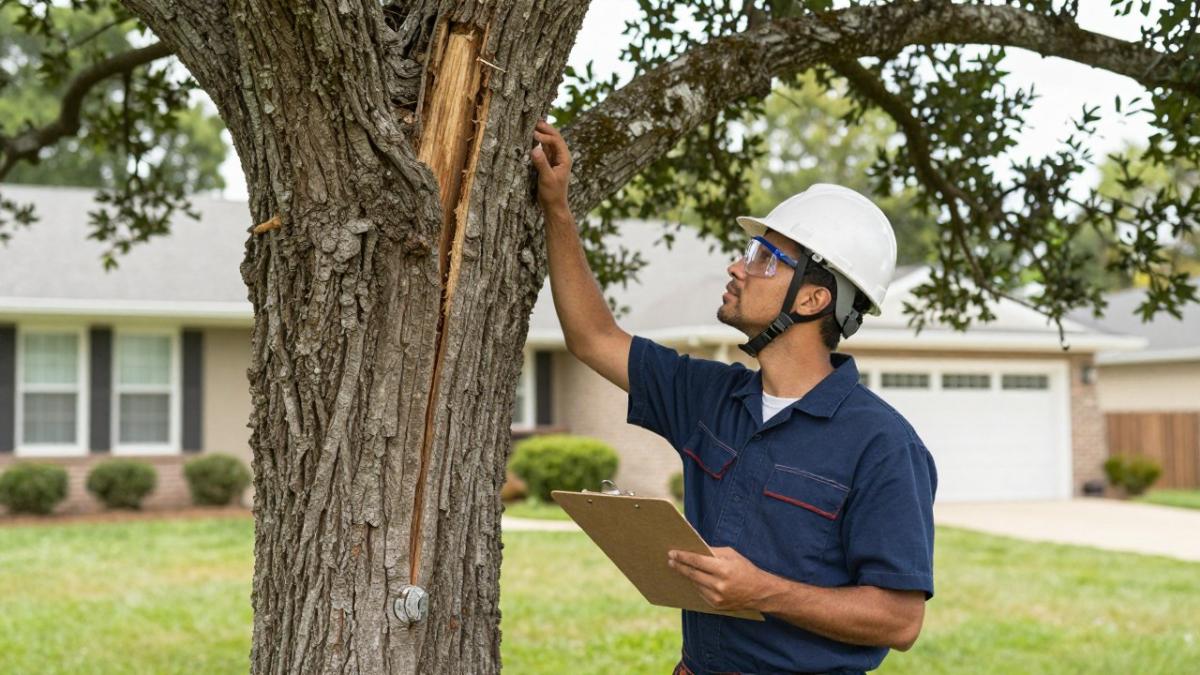
The 10/20/30 Rule for Reading Tree Structure
When a tree has two trunks of similar size sharing a narrow V-shaped union, that seam can be a failure point. If you spot it over a roof or driveway, get it assessed before the next windstorm. For a fuller list of danger signals, read our breakdown of 7 warning signs a tree is dangerous.
How to Rank Hazards and Decide What Needs Urgent Action
Most homeowners see several defects at once and don't know where to start. Prioritize based on the defect, the target, and the exposure.
Tier 1, Act now (within days). Any defect that meets a high-value or occupied target, or that involves a utility line.
Tier 2, Schedule within the season. A defect with a moderate target and no immediate trigger.
Tier 3, Monitor. A defect with no target or a low-value target.
Watch out: a defect that looks minor from the ground can be a Tier 1 problem if the tree is large or the target is occupied.
Document each tier with a photo and a date. If you ever need to show that you acted reasonably, that record is your proof.
Tree Pruning Tips That Protect Canopy Health
Pruning is the single most misunderstood part of tree maintenance. Homeowners often cut too much, at the wrong time, in the wrong place. The result is a tree that sprouts weakly, invites pests, and grows back worse than before.
Three rules cover most of it:
- Make the right cut. Cut just outside the branch collar, the swollen ring where the branch meets the trunk. No flush cuts, no stubs.
- Time it right. Late winter dormancy is ideal for most species. Avoid heavy pruning right after a tree leafs out.
- Remove the three Ds first. Dead, damaged, and diseased wood comes out before anything else.
The 1-2-3 Rule and the 25% Canopy Limit
The 1-2-3 rule keeps cuts in proportion: a branch you remove should be no more than one-third the diameter of the trunk it grows from. The 25% canopy limit caps how much live growth you take off in a single season. Never remove more than 25 percent of a tree's live canopy in one year. Cross that line and the tree spends its stored energy regrowing leaves instead of defending itself. Our tree pruning tips guide covers species timing in detail.
Tree Disease Signs Every Homeowner Should Recognize
Disease rarely announces itself. It shows up as small changes you notice over weeks. The TCIA tree care industry insights note that tree care injuries remain a persistent industry problem, but the quieter threat to your landscape is a pathogen you never identified.
Watch for these tree disease signs:
- Leaf discoloration that appears in one section rather than evenly
- Premature leaf drop in midsummer
- Cankers: sunken, discolored patches on bark
- Wilting on one side of the tree, even with adequate water
- Sawdust-like frass or exit holes from borers
- Oozing sap where there should be none
One-sided decline is the tell that separates disease from a watering problem. If half the canopy is failing while the other half looks fine, something is blocking the vascular system on that side. Our guide to signs a tree is diseased walks through all seven warning signs and what each one usually means.
Watering, Mulching, and Soil Care in the Root Zone
Most tree problems start underground. The root zone extends well past the drip line, often two to three times the width of the canopy.
Watering: Deep, infrequent watering beats daily sprinkling. Soak the root zone slowly so water reaches 12 to 18 inches down, then let the top few inches dry before watering again.
Mulching: Spread 2 to 4 inches of organic mulch in a wide ring around the trunk. Keep it a few inches back from the bark. Mulch piled against the trunk holds moisture where it shouldn't and invites rot and rodents.
Soil and roots: Avoid driving over the root zone. If construction is planned near a tree, fence off the root protection area before equipment arrives. Soil compaction is permanent; roots don't recover from it.
Fertilizing and Pest Prevention Without Overdoing It
Fertilizer is not tree food. It is a supplement, and most established trees don't need it. Over-fertilizing pushes fast, weak growth that pests love and that snaps in wind. Test the soil first. If phosphorus and potassium are adequate, you likely need nothing. If you do fertilize, do it in early spring as growth begins, and use a slow-release formula.
Pest prevention works the same way: build tree health rather than spraying on a schedule. A stressed tree sends chemical signals that borers and beetles detect. Keep the tree watered, mulched, and properly pruned, and you remove the invitation. Scout for pest infestation monthly during growing season. Look at the undersides of leaves, along branch crotches, and at the base of the trunk. Spot an outbreak early and a targeted treatment can work.
A Seasonal Maintenance Calendar for Wisconsin Properties
Timing matters more than effort in tree maintenance. A task done in the wrong month can weaken a tree or waste your money. The calendar below turns general advice into a month-by-month plan you can actually follow.
| Month | Primary Tasks | What to Watch For |
|---|---|---|
| January | Structural pruning on dormant trees; remove deadwood | Ice loading, snow-bent limbs, fresh cracks after freeze-thaw |
| February | Finish dormant pruning before buds swell; inspect root flares | Heaving soil, fungal conks exposed by bare canopy |
| March | Soil test; refresh mulch before growth starts; scout for early borers | Bark cracking from rapid temperature swings |
| April | Deep-water newly planted trees; check stakes and ties | Wilting on one side, cankers becoming visible |
| May | Scout leaf undersides and branch crotches for pests; light corrective pruning | Aphid honeydew, borer exit holes, premature leaf drop |
| June | Deep watering during dry spells; avoid heavy pruning | One-sided decline, chlorosis, scorch on exposed leaves |
| July | Monitor drought stress; refresh mulch if thin | Leaf drop in midsummer, wilting despite moist soil |
| August | Second pest scouting pass; plan fall planting | Sawdust-like frass, oozing sap, bark lesions |
| September | Final structural inspection before wind season; plant new trees | Weak branch unions, cavities, root plate movement |
| October | Clean up fallen leaves and debris; water evergreens before freeze | Storm cracks, split trunks after early snow |
| November | Hazard assessment after leaf drop; remove deadwood | Widow-makers, leaning that changed since spring |
| December | Emergency response readiness; avoid pruning during hard freeze | Ice storms, snow load on weak limbs |
Late winter pruning wins because the tree is dormant and the structure is visible without leaves. Spring is for feeding the soil, not the tree. Summer is about water. Fall is your last chance to catch a defect before storms arrive.
Watch out: pruning in late spring or early summer can expose fresh cuts to borers and fungal spores when trees are least able to seal them.
This rhythm is why residential tree care is a year-round habit, not a spring project. Keep a simple log of what you did each month and what you saw.
Tree Maintenance Responsibility: Who Handles What on a Residential Property
Tree maintenance responsibility usually follows the property line, not the tree's branches. A tree belongs to the owner of the land where its trunk sits. If your neighbor's tree drops a limb on your roof, that limb is generally your problem to clean up; the tree itself remains theirs. If a tree on your property is hazardous and you've been warned, liability shifts toward you.
Know the split:
- Your responsibility: trees rooted on your land, including pruning and removal
- Neighbor's responsibility: trees rooted on theirs
- Shared lines: get any agreement in writing before work begins
- Utility easements: the utility owns and maintains trees near its lines
Document everything. Photograph problem trees, keep inspection notes, and save any written notice you give a neighbor about a hazard. If a dispute heads toward court, paperwork is what settles it.
Utility Lines, Storm Damage, and When to Step Back
Power lines are the line you never cross. Energized lines can kill from a distance through a conductive branch, a ladder, or a wet rope. If a limb is touching or near a line, stop. Call the utility. That is not a job for a homeowner or a general handyman.
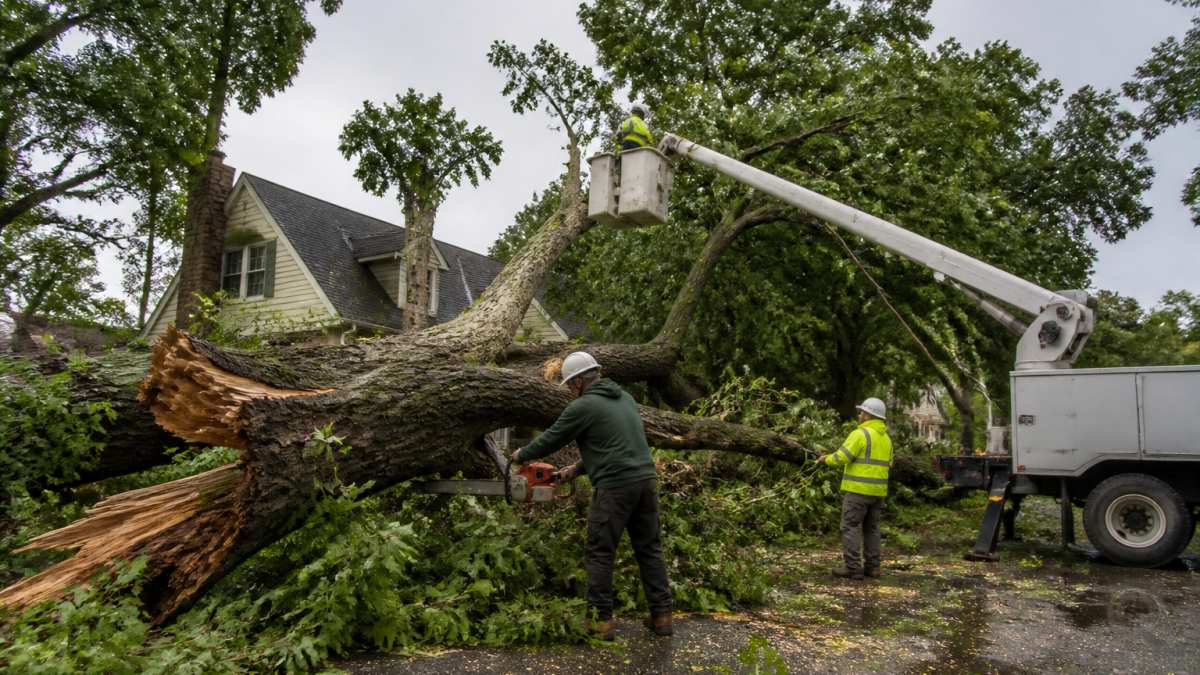
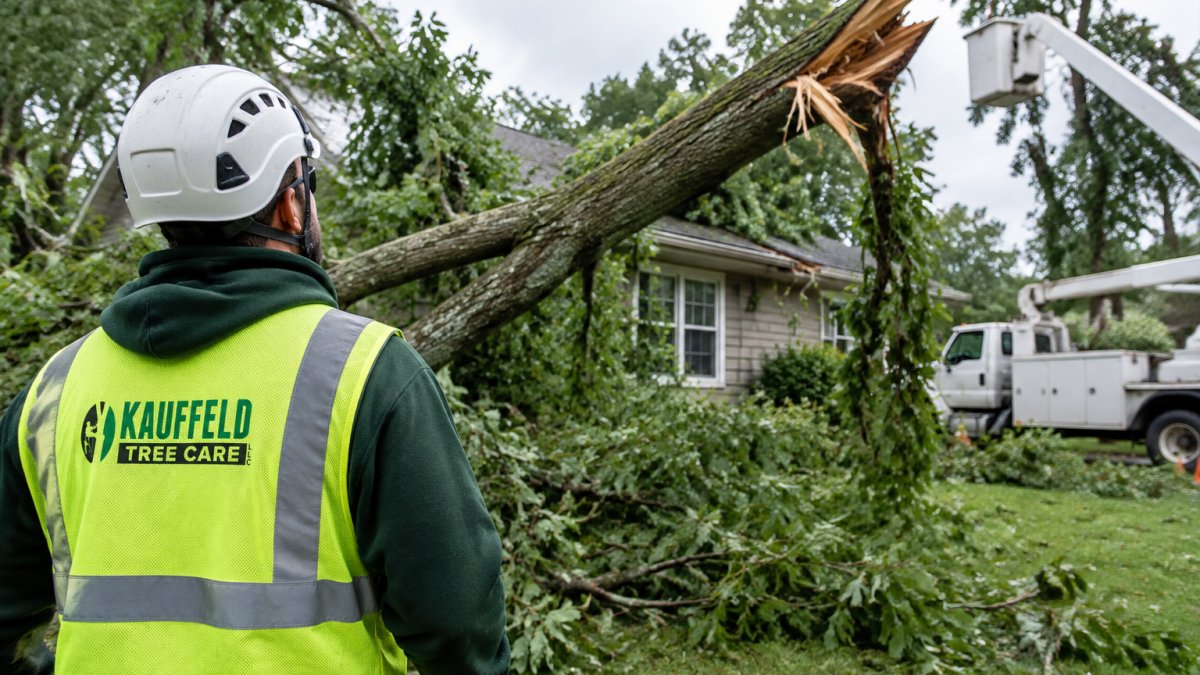
Storm damage creates the same trap. A tree leaning on a house may look stable and be under tension that releases the moment you cut the wrong limb. Storm cleanup kills people every year because someone with a chainsaw misreads which way the wood wants to go.
Step back when you see:
- Any contact with power lines
- A tree resting on a structure
- A split trunk still standing
- Root plate lifted out of the ground
- Chainsaw work above shoulder height
After a storm, we handle rapid storm damage cleanup to restore safety to the property. Our emergency storm tree cleanup guide covers the first steps homeowners can take safely while waiting for help.
DIY or Professional Arborist: Decision Rules for Homeowners
Some tree work is safe to do yourself. Most of the dangerous work is not. Use these rules:
Do it yourself if:
- The branch is under 2 inches in diameter
- It's within reach from the ground with a pole saw
- Nothing is beneath it but lawn
- The tree is healthy and the cut is clean
Call a professional arborist if:
- Any part of the tree is near a power line
- The work requires a ladder above 6 feet
- The tree is leaning, split, or hollow
- A crane or bucket truck is needed to reach it safely
- The tree is over a roof, driveway, or fence
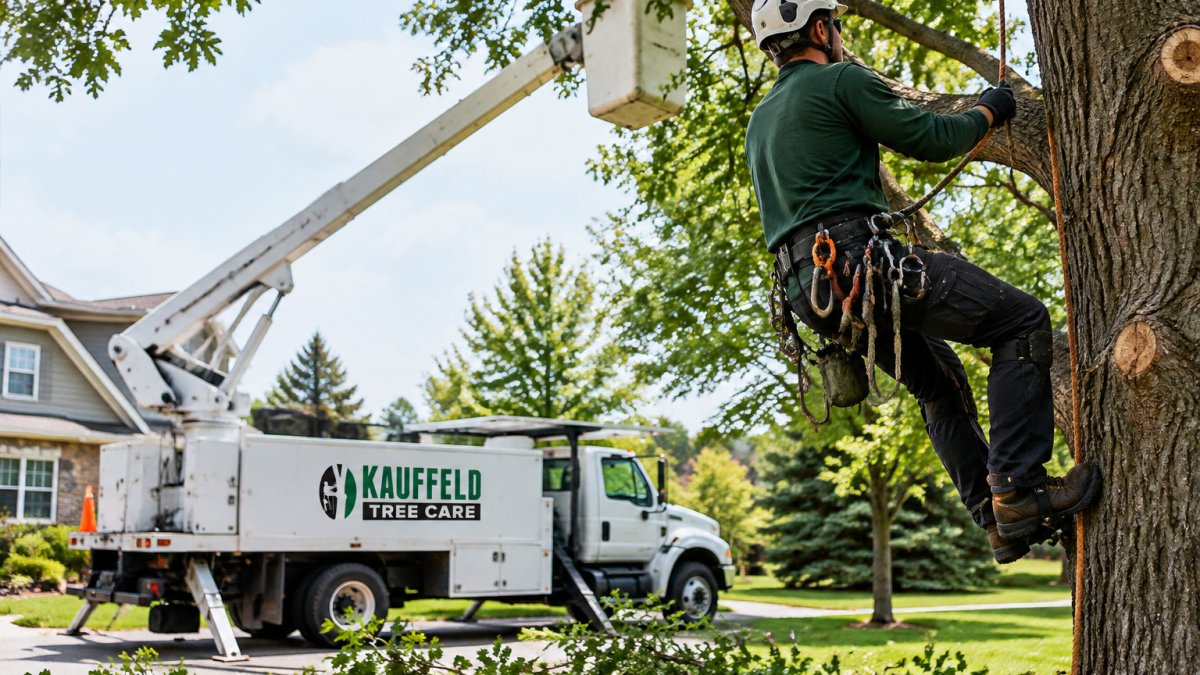
A certified arborist carries the training to read tree structure. Our team is certified and fully insured, and we use bucket trucks and cranes for hazardous or hard-to-reach removals. If you're hiring, read our guide on hiring insured tree care companies before you sign anything, and use our guide to finding local tree removal experts to shortlist qualified crews.
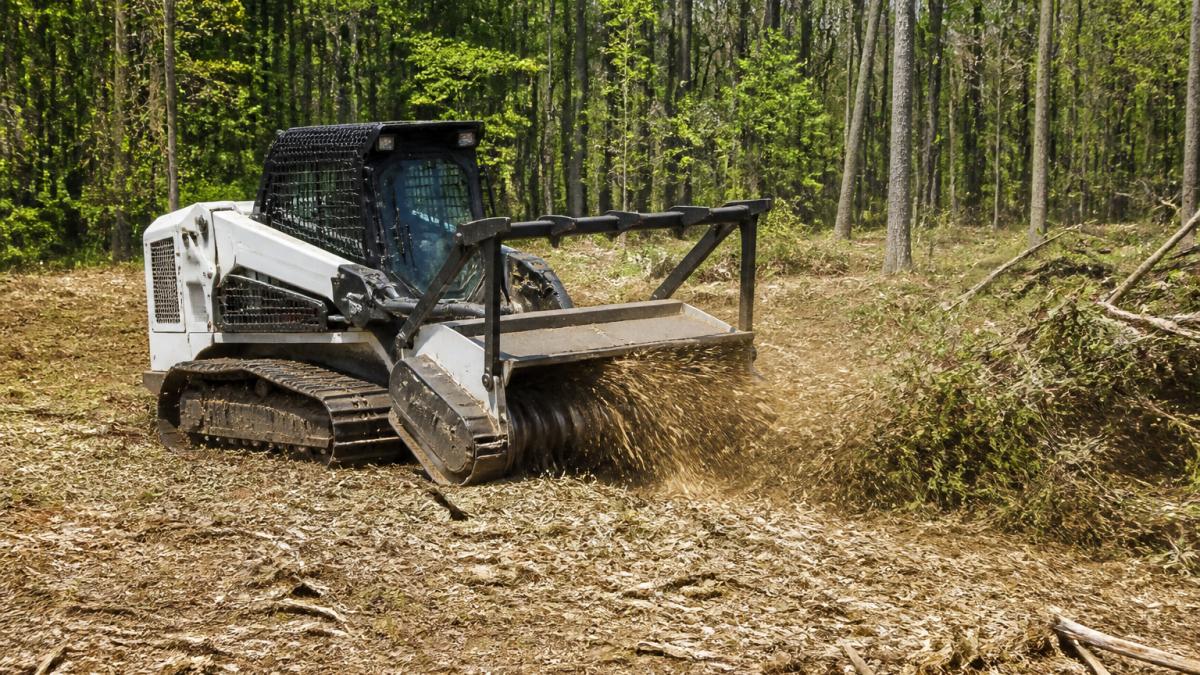
If a tree on your property is leaning, cracked, or hanging over the house, don't wait for the next storm to decide. Kauffeld Tree Care offers certified arborist assessments, crane-assisted removal for hazardous trees, and 24-hour emergency service across the Watertown area. We're fully insured, and we handle everything from a single dangerous limb to full lot clearing and stump grinding.
Frequently Asked Questions
What is the 10/20/30 rule for trees?
Structural checks for mature trees look at whether a tree has one dominant trunk, how high its lowest permanent branches sit, and how far its canopy spreads. When a tree fails these proportions, it often has competing leaders or weak branch unions that raise the risk of storm damage. A tree hazard assessment can confirm whether the structure needs cabling, bracing, or removal.
How often should residential trees be inspected?
Walk your property at least twice a year, once in spring and once in fall, and look for dead branches, cracks, and fungal growth. Large mature trees near a house, driveway, or power lines deserve a professional inspection every one to three years. After any major storm, check for hanging limbs and soil heaving around the root zone before mowing or parking underneath. Regular tree inspection catches problems while they are still cheap to fix.
How can you tell if a tree is diseased or hazardous?
Look for tree disease signs such as thinning canopy, discolored leaves, shelf fungi on the trunk, oozing sap, and dead branches on one side. Hazard signs are different: cracks in the trunk, mushrooms at the base, a lean that appeared recently, and exposed roots. A tree can be diseased for years without being an immediate hazard, and a healthy-looking tree can still fail. When both sets of signs overlap, call a certified arborist for a tree hazard assessment.
When should you hire a professional tree service?
Call a professional when a tree is within falling distance of a house, shed, or vehicle, when branches touch energized power lines, or when the trunk is larger than you can safely handle with a pole saw. Tree pruning tips that work on small ornamental trees do not translate to a 60-foot oak leaning over a roof. Crane and bucket truck work, cabling, bracing, and storm cleanup all call for insured crews with the right equipment.
Who is responsible for maintaining trees on a residential property?
In most cases, tree maintenance responsibility falls on the owner of the land where the trunk sits, even if branches hang over a property line. A neighbor generally has the right to trim limbs that cross onto their side, but only up to the property line and only if the tree stays healthy. Local ordinances can add rules for street trees and permit requirements. Check with your municipality before removing a tree near a right-of-way.
Can I prune my own trees, or is it too risky?
You can handle small limbs under about 2 inches in diameter that you can reach from the ground with a pole saw or loppers. Stop there. Climbing with a chainsaw, working near power lines, and removing large limbs are the leading causes of serious tree care injuries, and tree work is hazardous. Leave the rest to a certified arborist.