 How-to
7 Warning Signs a Tree Is Dangerous and Needs Removal
Last Updated: November 1, 2026
Quick Summary
The signs a tree is dangerous include dead or hanging branches, mushrooms or conks on the trunk, trunk cracks and cavities, root damage, a new or worsening lean, peeling bark, and dead wood through the crown. A tree is dangerous when a defect could cause failure that hits a target, so spot two or more signs and call an arborist.
- A hazard tree needs both a structural defect and a target it could strike, such as a house or person.
- Fungal fruiting bodies like brackets and mushrooms mean decay is already inside the wood.
- Keep people at least one and a half times the tree's height away from a suspect tree.
- An old, set lean on firm ground is usually a monitoring item, not an emergency.
- Recommend removal for a hollow trunk, deep split, root failure, or multiple major defects.
Table of Contents
- How to Tell If a Tree Is Dangerous: Start With Risk
- The Main Warning Signs of a Dangerous Tree
- Tree Trunk Cracks, Splits, and Cavities
- Tree Root Damage and Signs of Instability
- Leaning Tree Warning Signs: Normal Lean vs. Hazardous Lean
- Signs a Tree Needs to Be Removed, Not Just Trimmed
- Frequently Asked Questions
How to Tell If a Tree Is Dangerous: Start With Risk
Knowing the signs a tree is dangerous starts with one rule: a tree is dangerous when it has a defect that could cause it to fail, and when that failure would hit something that matters.
The signs a tree is dangerous almost always fall into a few clear groups: dead wood, decay, trunk defects, root problems, and lean. Spot two or more on the same tree and you should stop treating it as a cosmetic issue.
What Makes a Tree a Hazard
A hazard tree is a tree with a structural defect that could fail and strike a target. The target can be a house, a driveway, a power line, or a person.
The University of California Statewide IPM Program frames it the same way: a tree becomes hazardous when a defect could lead to failure that damages property or threatens safety, as outlined in its guidance on recognizing hazardous trees.
So the first question is never "does this tree look bad?" It is "what would this tree hit if it came down?"
The Main Warning Signs of a Dangerous Tree
Here are the visible symptoms to check first, in rough order of urgency:
- Dead or hanging branches overhead
- Mushrooms or conks on the trunk or at the base
- Cracks, splits, or cavities in the trunk
- Root damage, soil cracks, or exposed roots
- A new or worsening lean
- Peeling bark, missing bark, or pest damage
- Dead wood through the crown
One sign alone is a reason to look closer. Several together is a reason to call.
Dead Wood, Dead Branches, and Hanging Limbs
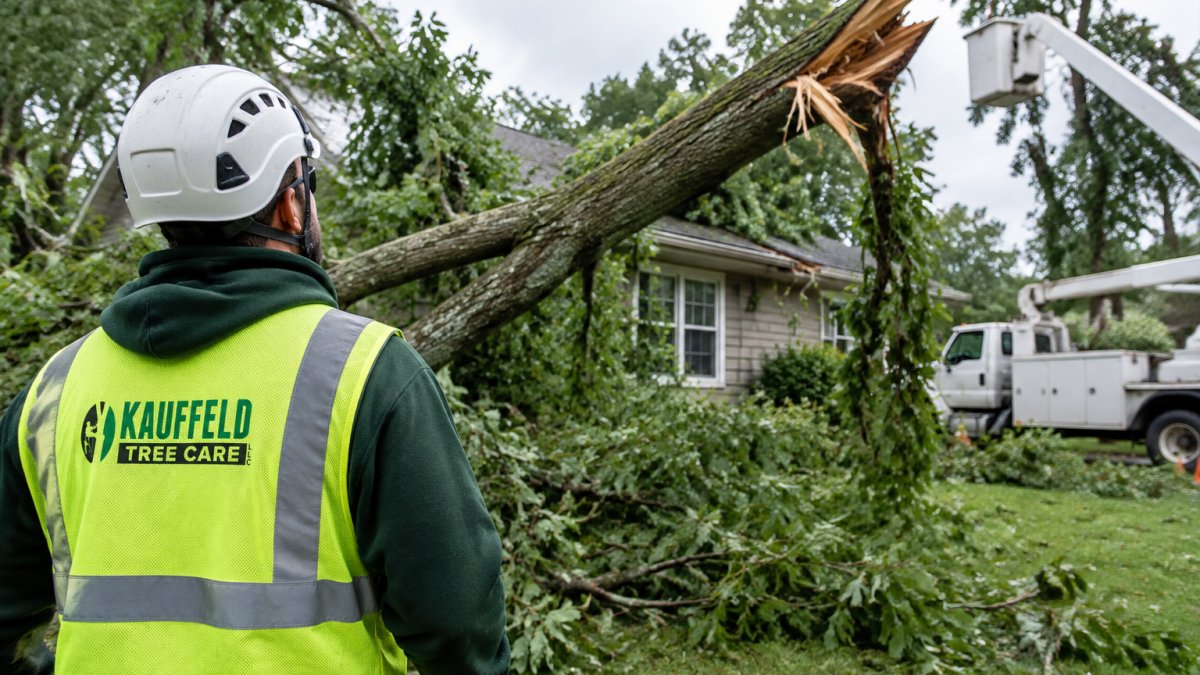
Dead branches are the most common cause of falling limbs, and hanging limbs are the most urgent. A limb broken but still caught in the canopy can drop without warning, especially after rain or wind.
Look for:
- Bare branches with no buds in spring
- Branches that snap cleanly instead of bending
- Limbs hanging at an odd angle, caught in other branches
If a hanging limb sits over a walkway, driveway, or roof, keep people out from under it until it is removed. Our guide to emergency storm tree cleanup explains how emergency storm tree cleanup works.
Decay, Rot, and Fungal Growth Near the Base
Fungal growth on or around a tree is a structural warning, not a cosmetic one. UC IPM lists fungal fruiting bodies, brackets, conks, and mushrooms on bark or around the tree, as signs a tree may be hazardous.
Watch for:
- Shelf-like brackets on the trunk
- Mushrooms clustered at the base
- Soft or crumbly wood under the bark
Fruiting bodies mean decay is already inside the wood. If you are unsure whether rot means disease or simple age, our guide to the signs a tree is diseased walks through the difference.
Tree Trunk Cracks, Splits, and Cavities
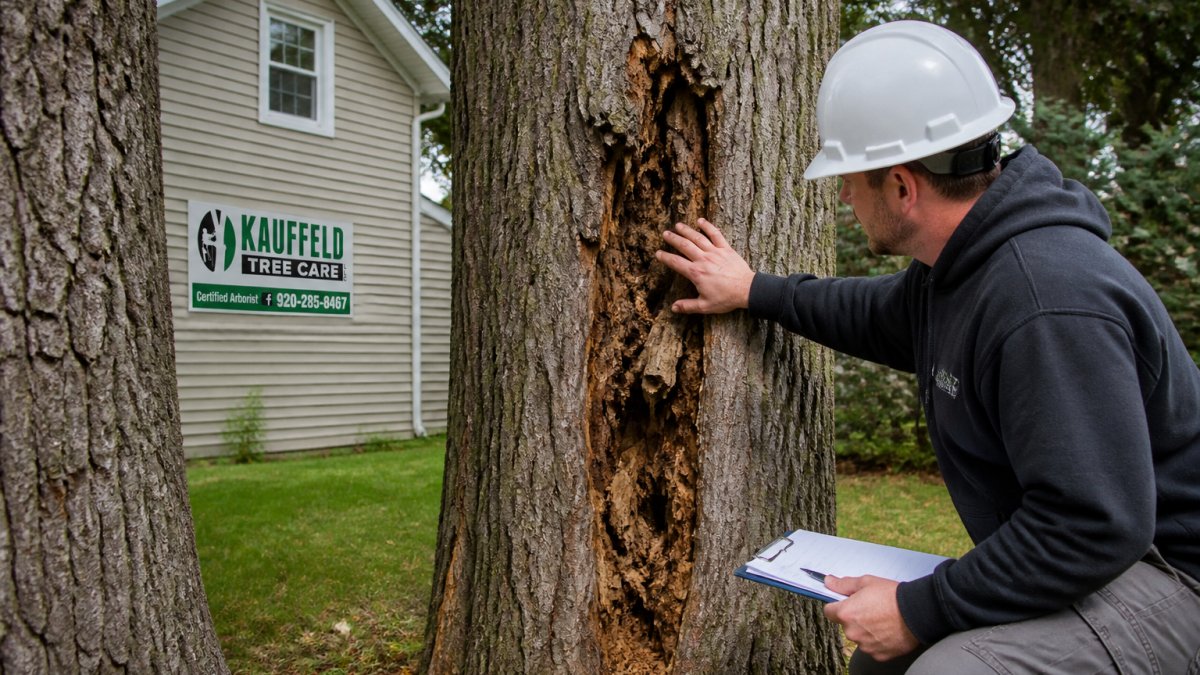
Cracks, splits, and cavities in the trunk point to structural weakness, and a deep vertical crack is one of the most serious defects we see.
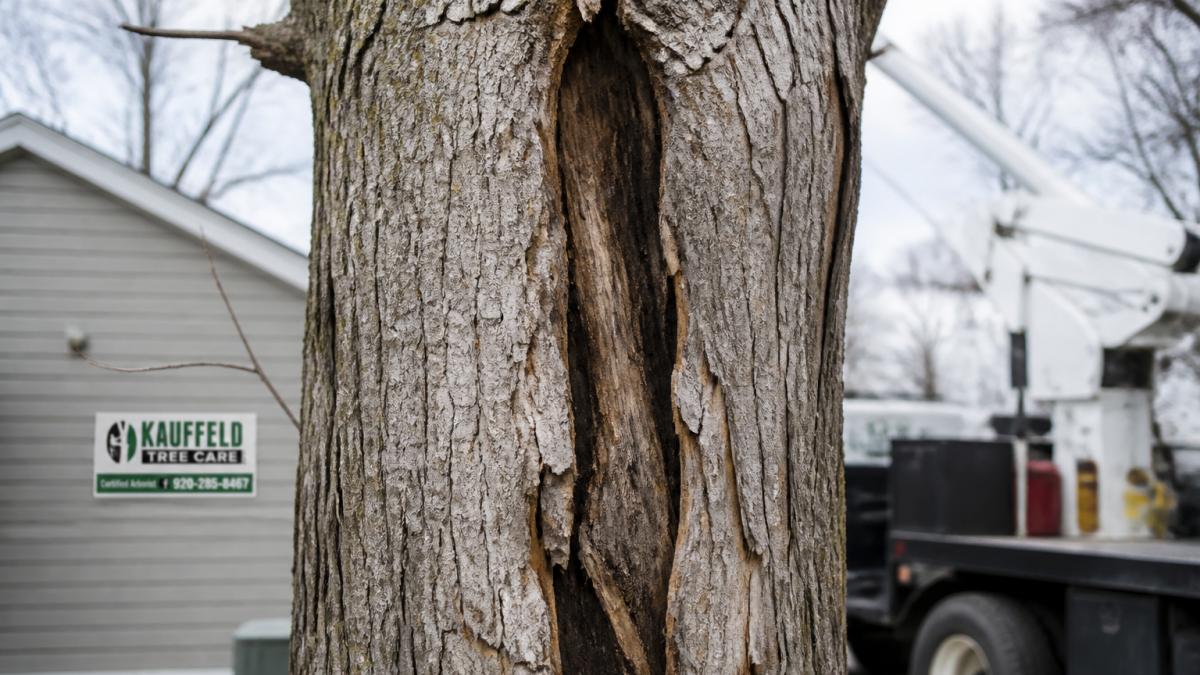
Check for:
- Vertical cracks running up the trunk
- Splits where two stems pull apart at a fork
- Cavities or holes with soft wood inside
One important caveat: splits and cracks are potential warning signs, not hard-and-fast rules. A video on spotting dead or dying trees makes the same point.
Tree Root Damage and Signs of Instability
Root problems are the hardest defects to see, and the most likely to cause a whole tree to fall. The root system anchors the tree, so damage below ground undermines everything above it. Root and root-plate failures are a common cause of whole-tree failures.
Signs of root damage or instability include:
- Mushrooms growing in a ring around the base
- Soil cracking or lifting on one side
- Exposed or severed roots from digging
How Root Failure Actually Happens
A tree is held up by its root plate, the shallow mat of roots and soil directly under the trunk. When roots are cut, decayed, or drowned by saturated soil, the plate loses grip.
Construction, trenching, and even a new driveway can cut roots on one side and leave the tree unstable without any visible change in the canopy. Roots extend well beyond the drip line, so digging within that zone can damage roots in ways that are not immediately visible.
Test for Instability Without Putting Yourself at Risk
Do not push hard on a large tree to see if it moves. A tree that is close to failing can come down on the person testing it. A safer check is visual and from a distance:
- Stand outside the fall zone, at least one and a half times the tree's height away.
- Look for a gap or crack in the soil on the side opposite the lean.
- Check whether the trunk base is heaving out of the ground.
- Note whether the crown is thinning on one side only.
If you see soil lifting, a fresh crack, or a root plate pulling out of the ground, stop and keep people away. That pattern is an emergency, not a wait-and-see item.
Why Location Changes the Urgency
A root-compromised tree in an open field is a different problem from one over a bedroom. The defect is the same, but the consequence is not. A tree within falling distance of a house, driveway, road, play area, or utility line should be assessed sooner. When you call, describe what the tree could hit, that helps an arborist prioritize the visit.
Leaning Tree Warning Signs: Normal Lean vs. Hazardous Lean
A leaning tree is not automatically a problem. Many trees grow with a lean for decades and stay stable. The question is whether the lean is old and set, or new and moving. That distinction, change over time, is the most useful thing you can check, and the part most warning-sign lists skip.
Here is how we tell them apart:
| What to Check | Normal Lean | Hazardous Lean |
|---|---|---|
| History | Present for years | New or getting worse |
| Soil at base | Flat and firm | Cracked or lifted on one side |
| Root plate | Intact | Exposed or heaving |
| Trunk shape | Curved, gradual | Straight and tilted |
| Crown | Balanced | Thinning or dying on one side |
How to Tell If a Lean Is New or Getting Worse
You cannot judge a lean from a single look. You need a baseline. Pick two fixed reference points, a fence post and a window, for example, and note where the trunk sits against them.
Soil movement is the tell. When a root plate starts to hinge, the ground on the side opposite the lean cracks, lifts, or forms a gap at the trunk.
What a Sudden Lean Means
A sudden lean after a storm, or one that has visibly increased over a season, usually means the root plate has shifted. Saturated soil makes this worse: after heavy rain, the soil loses strength and a tree with a compromised root system can rotate with little warning. If a tree leans after a storm and the ground at the base is disturbed, treat it as potentially unstable and have it assessed promptly.
What to Do Immediately
- Keep people and vehicles out of the fall zone, at least one and a half times the tree's height in every direction.
- Do not try to straighten, stake, or pull the tree.
- Photograph the base and the lean from a safe distance, and note the date.
- Call a qualified arborist and describe the lean, the soil movement, and what the tree could hit.
For a leaning tree close to a house, the removal method matters as much as the decision. Our guide to how to safely remove leaning trees explains how leaning trees are safely removed.
Signs a Tree Needs to Be Removed, Not Just Trimmed
Trimming fixes problems in the canopy. Removal is the right call when the trunk, roots, or main structure are compromised. No amount of pruning makes a hollow trunk strong again.
We recommend removal when a tree shows:
- A cavity or hollow covering a large share of the trunk
- A deep split through the main stem
- Root failure or a shifting root plate
The International Society of Arboriculture's literature review on tree risk assessment notes that, when a target is present, tree failure can damage property, disrupt services, or threaten public safety, as summarized in the ISA review of tree risk literature.
Once removal is likely, two things matter most. Our guide to hiring insured tree care companies covers how to hire an insured tree care company. First, hire a fully insured tree care company. Second, choose a provider who can handle the tree without damaging what is around it. Our guide to finding local tree removal experts helps you find local tree removal experts.
If you are looking at a tree that worries you right now, do not wait for it to prove the point.
Frequently Asked Questions
How can you tell if a tree is at risk of falling?
Look for a cluster of warning signs rather than a single one. A dangerous tree often shows dead or hanging branches, fungal growth at the base, cracks or cavities in the trunk, and disturbed soil around the roots. A sudden lean that appears after a storm is a stronger signal than a lean the tree has carried for years. When several of these signs appear together, treat the tree as a hazard and keep people and vehicles clear until a certified arborist inspects it.
Does a leaning tree always mean it is dangerous?
No. Many trees grow with a natural lean and stay stable for decades. The concern is a lean that develops quickly, especially after heavy rain or wind, or one paired with cracked soil, exposed roots, or a curved trunk base. A newly developing lean points to root or structural failure. A lean that has been consistent for years with no other symptoms is usually a lower risk, but an inspection confirms it.
Are cracks in a tree trunk a sign of danger?
Tree trunk cracks are potential warning signs, not automatic proof of failure. A shallow surface split may be harmless, while a deep, wide, or newly opened crack that runs along the trunk can point to structural weakness. Cracks combined with decay, cavities, or fungal growth raise the risk. A certified arborist can assess how deep the damage goes and whether the tree can be saved or should be removed.
When should you call an arborist about a dangerous tree?
Call a certified arborist when you see multiple warning signs at once, when a tree leans toward a house, driveway, or power line, or when storm damage leaves broken limbs hanging. If a tree has already dropped large limbs or shows root damage, avoid working near it yourself. Kauffeld Tree Care offers 24-hour emergency service in the Watertown area for hazardous and storm-damaged trees, so you can get a professional assessment before the situation gets worse.
A tree with several warning signs is a problem you cannot solve with a saw and a weekend. It needs an arborist who can read the defect, judge the target, and remove the tree without putting your house or your family at risk. Kauffeld Tree Care offers certified arborist assessments, fully insured crews, 24-hour emergency service, and crane removal for hazardous or hard-to-reach trees. Get started with Kauffeld Tree Care and get that tree handled safely.