 How-to
Can You Trim Branches Near Power Lines Yourself?
Last Updated: November 15, 2026
Quick Summary
You should never do power line tree trimming yourself if any part of the branch could contact a power line, because electricity can jump and wet limbs conduct current. Call your utility for lines on poles and a licensed, insured tree service for work on your side of the meter.
- Federal data reports 99 tree trimmers killed on the job in 2024, with falls and struck-by incidents each about 40%.
- Stay at least 35 feet back from any tree that has already fallen onto a power line.
- Call 811 before any digging near a tree's root zone and confirm who owns the line.
- Utility crews cut for clearance, not tree health, and often leave debris and stumps to you.
- Ask for directional pruning to a lateral branch instead of topping a line-side tree.
Table of Contents
- Why Safe Tree Trimming Near Power Lines Is Never a DIY Job
- Tree Branches Touching Power Lines: Clearance Rules and Warning Signs
- Power Line Tree Trimming Safety: Step-by-Step for the Homeowner
- Who to Call for Trees Near Power Lines
- Utility Company Tree Trimming: What They Do and What They Leave to You
- When to Call a Certified Arborist for Hazardous Trees
- Frequently Asked Questions
Why Safe Tree Trimming Near Power Lines Is Never a DIY Job
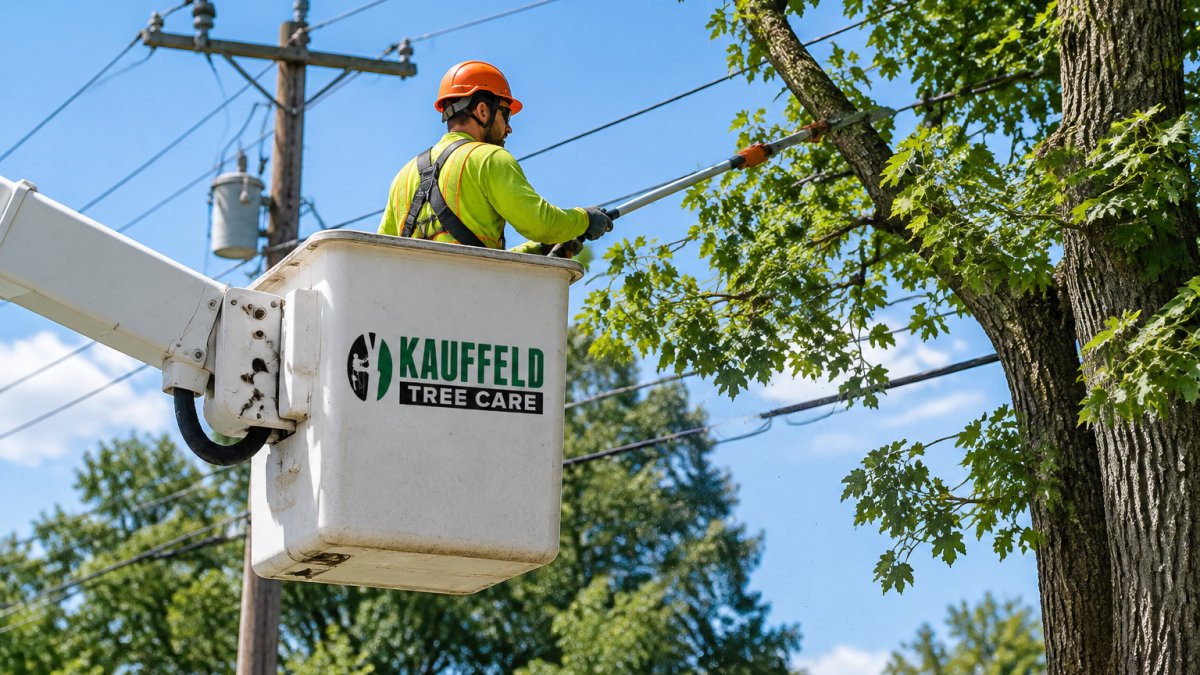
Safe tree trimming near power lines is work that belongs to trained professionals, full stop. One wrong cut near an energized conductor can kill you before you hear a sound.
The numbers back that up. Federal fatality data summarized by Start Business by State's tree work safety statistics reports 99 tree trimmers killed on the job in 2024, with falls and struck-by incidents each accounting for roughly 40% of those deaths.
At Kauffeld Tree Care, we get calls every spring from people who want to know if they can just take off "one branch." Here is the honest answer: if any part of that branch could contact a power line, no.
Three things make this different from normal trimming:
- Electricity jumps. You do not need to touch a line to be electrocuted.
- Branches conduct. A wet limb touching a wire energizes everything it touches, including you.
- Trees near lines are often already damaged. Hidden cracks fail mid-cut.
If you want to handle safer, lower-risk yard work yourself, start with residential tree maintenance and safety tips for homeowners. Just leave anything near a wire alone.
Tree Branches Touching Power Lines: Clearance Rules and Warning Signs
Tree branches touching power lines are the single biggest warning sign that a job is out of your hands.
Utilities set clearance zones by voltage class and by the type of line.
A useful way to think about it: clearance is measured from the conductor to the nearest part of the tree, not from the trunk.
Watch for these signs that a tree near a line needs professional eyes:
- Limbs resting on, wrapped in, or growing through wires
- Scorched, blackened, or pitted bark on the line side of the tree
- Branches growing into the service drop between the pole and your meter
- A tree leaning toward the wires after a storm, even slightly
- Cracked trunks, split crotches, or conks (fungal fruiting bodies) on a line-side tree
- Sawdust or fresh wood chips at the base of a line-side tree, which can indicate previous unauthorized cutting
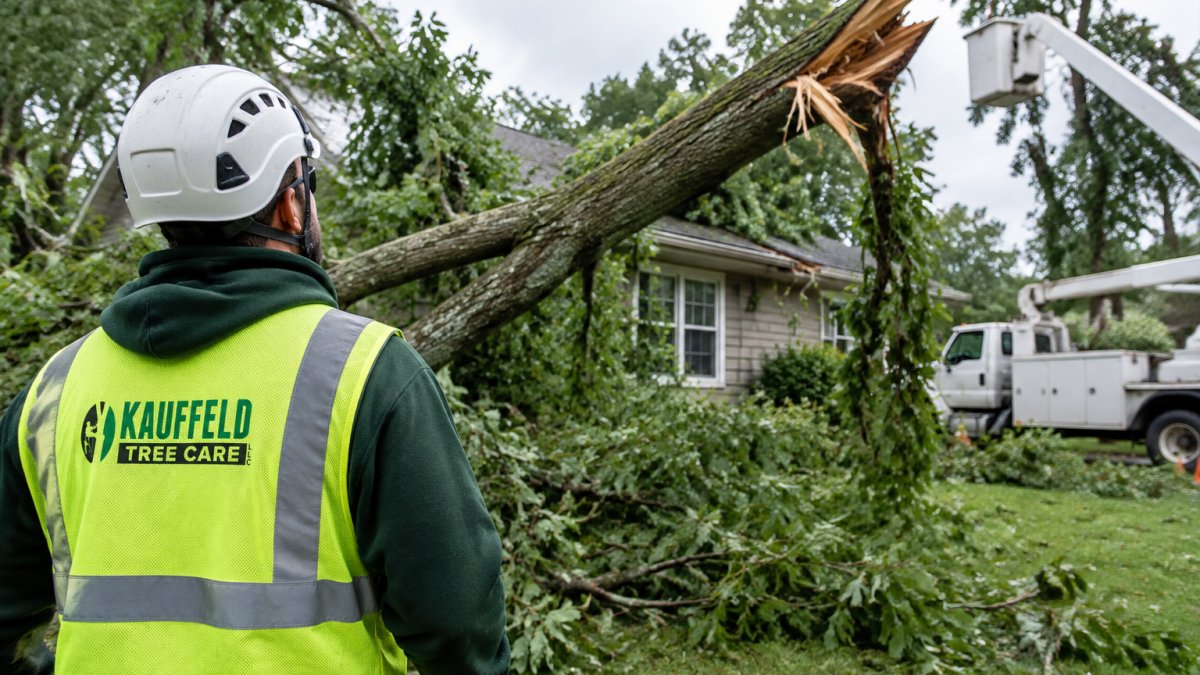
One more warning worth repeating: stay at least 35 feet back from any tree that has already fallen onto a power line, per Statement Tree's power line safety guidance.
These are the warning signs that mean a tree near a line needs professional eyes.
| Warning sign | What it looks like |
|---|---|
| Limbs on wires | Resting on, wrapped in, or growing through wires |
| Damaged bark | Scorched, blackened, or pitted bark on the line side |
| Service drop growth | Branches growing into the service drop between pole and meter |
| Post-storm lean | Tree leaning toward the wires, even slightly |
| Structural failure | Cracked trunks, split crotches, or conks on a line-side tree |
| Fresh cuttings | Sawdust or fresh wood chips at the base |
Power Line Tree Trimming Safety: Step-by-Step for the Homeowner
Power line tree trimming safety starts with knowing exactly where your responsibility ends. For most homeowners, that line sits well before the wire.
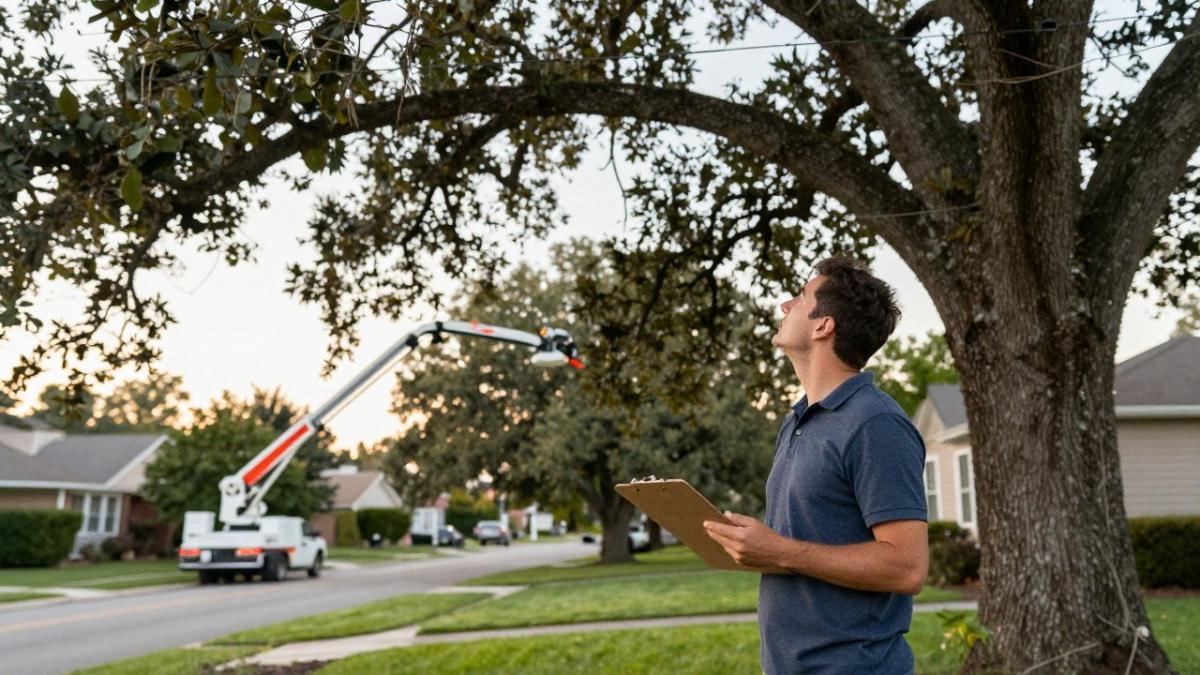
The man is American.
Here is the sequence we walk homeowners through.
Step 1: Assess the Tree From a Safe Distance
Stand back and look up. Note how close the nearest limb sits to the wire, and whether the tree looks healthy or failing. A tree with dead limbs, cracks, or a lean toward the lines is a hazard, not a project. Our guide to the warning signs a tree is dangerous and needs removal walks through what to look for.
Step 2: Call 811 and Confirm the Line Owner
Call 811 before any digging near a tree's root zone, and call your utility to confirm who owns the line. Service drops to the house are usually the homeowner's responsibility. Distribution lines on poles are usually the utility's. Get it in writing before anyone touches a saw.
Step 3: Clear the Ground and Set a Drop Zone
Move cars, furniture, kids, and pets well clear. Rope off a drop zone wider than the tree's canopy. Never work alone, and never work from a ladder anywhere near a line.
Step 4: Make Only the Cuts You Are Qualified For
If a branch is clear of all wires, well below them, and small enough to control with a pole saw from the ground, you may be able to handle it. Anything above that threshold goes to a pro. Watch out: the most common mistake we see is a homeowner cutting a limb that swings into a wire on the way down. That is how people die.
Who to Call for Trees Near Power Lines
Who to call for trees near power lines depends on where the tree sits. If limbs are touching or near the energized lines on the pole, call your utility first. They handle line clearance on their own equipment at no charge in most cases.
If the work is on your side of the meter, call a licensed, insured tree service. Before you hire anyone, read up on hiring insured tree care companies so you know what proof of insurance actually looks like. Then use a guide to finding local tree removal experts to compare quotes and check references.
Two quick screening questions for any crew:
- Can you show me a current certificate of insurance?
- Who handles the utility notification?
If they hesitate on either, keep calling.
Utility Company Tree Trimming: What They Do and What They Leave to You
Utility company tree trimming focuses on keeping lines clear, not on keeping your tree pretty. Crews cut for clearance, and the results can look rough.
What they typically handle:
- Limbs contacting or crowding primary lines
- Dead or dying trees that threaten the wires
- Storm-damaged branches on the line
- Line clearance on their own equipment, often at no charge to the homeowner
What they usually leave to you:
- Ornamental shaping and cleanup
- Stumps and debris on your property
- Trees that are near the line but not yet a clearance problem
- The health of the tree beyond what clearance requires
That last gap is where most disputes start. Utility crews are not arborists and are not paid to preserve form or health; they are paid to protect the line.
A practical decision framework:
- If the utility has already trimmed and left debris on your property, call the utility's vegetation management line and ask whether debris removal is included in their scope for your address. Policies vary by company and by whether the work was routine or storm-related.
- If the tree is near the line but not yet a clearance problem, the utility may decline to act. In that case, hire a licensed, insured tree service to prune for clearance on your side of the meter, and ask them to coordinate utility notification if the work will bring anyone near an energized conductor.
- If the tree is failing, leaning, or too large to control, stop and call a certified arborist. A hazardous tree near a conductor is a crane job, not a ladder job, and the utility is not obligated to remove a tree that has not yet contacted the line.
Watch out: do not hire a crew to "top" a line-side tree to satisfy a utility notice.
If a utility crew leaves a mess or a stub, that is normal.
When to Call a Certified Arborist for Hazardous Trees
Call a certified arborist when the tree near the lines is failing, leaning, or too large to control safely. A hazardous tree near a conductor is a crane job, not a ladder job.
Signs it is time to stop and call:
- The trunk is cracked, hollow, or leaning toward the wires
- Large dead limbs hang over the line
- The tree has already dropped branches
- Roots are exposed or the soil is heaving
If the tree is leaning and hazardous, our guide to safely removing leaning trees explains why this work needs rigging and, often, a crane.
If a tree on your property is crowding a power line, do not wait for the next storm to find out how bad it is.
Frequently Asked Questions
Can I trim tree branches near power lines myself?
Only if the branches are well clear of the lines and you can reach them from the ground with a pole pruner. Contact with a power line can be fatal. For anything within the utility's clearance zone, hire a professional or call the utility first.
Who should I call if a tree is touching a power line?
Call your utility company first. They own the lines and are responsible for keeping their easement clear, and many will send a crew at no charge if the tree is interfering with service. If the tree is on your side of the meter and needs shaping or removal, call a licensed, insured tree service with experience in power line tree trimming. Never touch the tree or try to pull a branch away yourself.
How close can tree branches be to power lines?
Clearance requirements vary by voltage, and high-voltage transmission lines require more distance than distribution lines. Confirm the exact clearance zone with your utility before you plan any cutting.
What should I do if a branch falls on a power line?
Assume the line is live and stay well back, keeping children and pets inside. Do not touch the branch, the tree, or anything in contact with the line, and do not try to move it with a tool. Call 911 to report the hazard and then call your utility company. Wait for their crew to clear the line before you schedule any cleanup of the fallen wood.